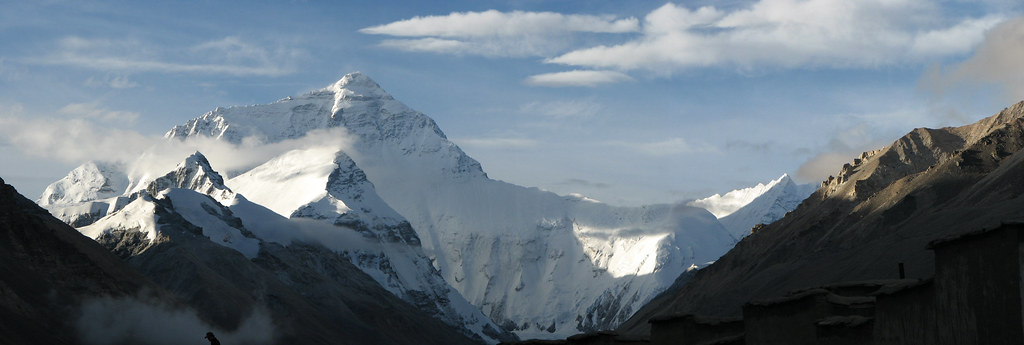
George Mallory and Andrew Irvine left their high camp at 8,170 metres on the north ridge of Everest at roughly half past eight on the morning of 8 June 1924. They were last seen by Noel Odell at about half past twelve in the afternoon, moving on the upper north-east ridge in a brief clearing of the cloud. They did not come down. Mallory's body was found on the upper north face by Conrad Anker on 1 May 1999. Irvine's body has not been found.
Whether Mallory and Irvine reached the summit is the most famous unsolved question in mountaineering. It has been asked, in print, since the autumn of 1924 and is asked again roughly every decade by a new generation of writers. The Mallory family papers at Magdalene College, Cambridge, are the archive everyone goes back to.
The collection was donated to Magdalene by Mallory's daughter Clare in 1986 and was substantially supplemented by his granddaughter Virginia Mallory in 2014. It runs to roughly four hundred items: letters, expedition diaries, climbing notebooks, photographs, and the contents of Mallory's pockets as recovered in 1999. The recovered items include an altimeter, a wristwatch with the glass missing, a compressed tin of beef extract, and a letter from his wife Ruth dated 16 March 1924.
The Ruth Mallory letter is the document the visitors come for. It is two pages, written from the family home in Cambridge, and was carried by Mallory in his breast pocket from England to the Everest base camp and up the north ridge to the high camp. It is unopened in the archive sense — Mallory had read it many times but it has not been transcribed or microfilmed for general circulation, on the family's request — though it is available for reading by accredited scholars in the Pepys Library reading room.
The letter is not a clue to whether he summited. It is a domestic letter, about the children, about the spring weather in Cambridge, about a planned summer holiday in Cornwall that did not happen. It mentions Everest twice. Both mentions are short. One reads, in part, I think of you on the mountain every morning, but mostly I think of you here, in the garden, with the children, in August.
What the archive does illuminate is the question of motivation. Mallory had told the journalist Walter Wagner, in March 1923 in New York, that he climbed Everest because it is there. The phrase has been quoted in every subsequent account of the climb. The archive shows that Mallory, in his private letters to Ruth in the months before the 1924 expedition, was substantially less certain.
In a letter dated 11 February 1924, written from the steamship California en route to Bombay, Mallory wrote to Ruth that he was tired, that this was his third expedition in four years, that he was thirty-seven and felt older. He wrote that he believed the mountain could be climbed but that he was no longer sure he was the man to do it. He wrote, in a sentence the Magdalene archivists have flagged but the family has not authorised for general publication, that the summit was less important than coming home.
He did not come home. The 1924 expedition's official account, The Fight for Everest, was edited by Edward Felix Norton and published in 1925. It treats Mallory's death as the conclusion of a heroic effort and does not speculate at length about whether the summit was reached. Norton's own account of his and Howard Somervell's earlier summit attempt on 4 June 1924 is the longest section of the book. Norton reached 8,572 metres without oxygen, which was the highest verified point on earth a human had stood for the next twenty-nine years.
Mallory's body, when Anker's expedition found it in 1999, was face down at 8,160 metres on a snowfield below the first step on the north-east ridge. The body was substantially intact, preserved by the cold and the dryness. The right leg was broken. The hands were extended above the head, as if Mallory had been trying to self-arrest at the moment of death. The hobnail boots were tied. A climbing rope was tied around his waist with a bowline. The other end of the rope had broken.
The 1999 expedition photographed the body extensively, removed certain items including the altimeter and the letters, and reburied the body under a small cairn at the location. The reburial was a courtesy at the family's request. The site is approximately on the standard north-ridge descent line and is passed by every party that climbs the north side. There is no marker.
The items recovered have been examined by historians of the climb in the intervening twenty-seven years. The altimeter, a brass Watkin-pattern, was found set to the high-camp pressure. It does not record a reading. The wristwatch had stopped, with the glass missing. Pollen analysis on a piece of cloth from the inner jacket pocket shows alpine flora consistent with the lower glacier, not with the upper mountain. None of this resolves the summit question.
The question that the 1999 finding did partially resolve was the position of the body. Mallory was below Irvine's last known position, suggesting that the fatal fall had been on the descent and not on the ascent. Whether the descent was from the summit or from a turnaround point below it remains unknown.
Irvine's body has been searched for in 1986, in 1999, in 2001, in 2004, in 2007, in 2010, and most recently in October 2024 by the American climber and historian Jamie McGuinness. The 2024 search focused on a snow-bench at 8,200 metres on the north face, where a body had been reported by a Chinese climber in 1975. The bench was found. The body was not. The 1975 sighting may have been Mallory.
The Mallory archive at Magdalene includes one item that the family released for general publication in 2018. It is a photograph of Ruth Mallory, dated 1923, that Mallory had told his climbing partner Geoffrey Bruce he would place on the summit if he reached it. The photograph was not found on the body in 1999. Anker's expedition searched the body's clothing carefully for it. It was not there.
The absence of the photograph has been read both ways. The summit-reached camp argues that Mallory placed the photograph on top, as he had said he would, and then died on the descent. The summit-not-reached camp argues that the photograph was lost separately, blown out of his pocket in the fall, or lost in the seventy-five years before the body was found.
The Magdalene archive will, by the terms of the family bequest, become fully public in 2050. The unpublished Mallory letters, including the Ruth Mallory correspondence and a series of letters to his climbing partner Geoffrey Winthrop Young, will be released for general scholarship at that date. Whether the letters will add anything to the summit question, the Magdalene archivist Joanna Lendon told the writer in March 2026, is impossible to know. She has read them.
The 1924 expedition is sometimes treated, in popular accounts, as a story about whether Mallory and Irvine reached the summit. The archive at Magdalene treats it as a story about what they were trying to do. The two stories overlap but are not the same. The letters Mallory wrote to Ruth from the steamer in February 1924 are clearer than the climbing diaries about what he was actually doing on that mountain.
He was, on the evidence of his own writing, climbing for the last time. He had told Ruth as much. He had told Geoffrey Winthrop Young the same thing in a letter from the base camp in May. Whether he summited or not, he had decided that 1924 was the end. The mountain made the decision permanent.