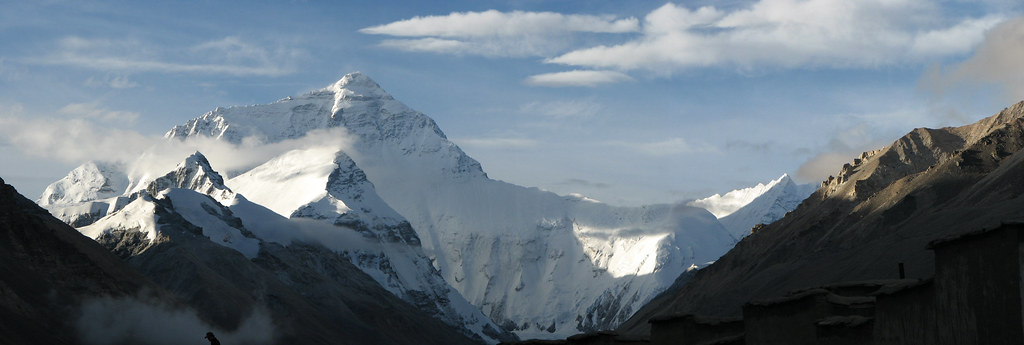
On the morning of 29 May 1953, at roughly half past eleven local time, Edmund Hillary and Tenzing Norgay stood on a snow dome at 8,848 metres and looked east. They stayed there for fifteen minutes. Tenzing left chocolate and a small pencil belonging to his daughter Nima. Hillary photographed Tenzing with his ice axe held overhead and did not ask for a photograph of himself, on the grounds that Tenzing had never operated a camera.
The expedition that put them there had left Kathmandu two months earlier with three hundred and fifty porters and roughly ten tonnes of stores. It was led by Colonel John Hunt, who was forty-two, and had been organised by the Joint Himalayan Committee of the Royal Geographical Society and the Alpine Club. The summit pair were chosen by Hunt at Camp IV on 7 May.
Hunt's decision is sometimes read as obvious. It was not. Tom Bourdillon and Charles Evans, equipped with the experimental closed-circuit oxygen sets, had reached the South Summit at 8,750 metres on 26 May. Evans's set malfunctioned on the descent. Hunt decided, on the evidence of two days of weather and the condition of the lead climbers, that the closed-circuit system was not reliable enough for a second push and that Hillary and Tenzing, on open-circuit sets, would go.
The oxygen sets are worth a paragraph of their own. The open-circuit equipment, designed in part by Peter Lloyd, weighed roughly fourteen kilograms with two bottles full. It delivered four litres a minute on the climbing setting. At the summit, Hillary's set had about an hour and a half of oxygen remaining. He turned the regulator down to two litres a minute on the descent and reached the South Col with the cylinders nearly empty.
The expedition's success has, for seven decades, been read primarily through the summit photograph and the coronation telegram. Both are true. James Morris, then the Times correspondent at Base Camp, sent the runner Cheke down to Namche Bazaar on 30 May with a coded message reading SNOW CONDITIONS BAD STOP ADVANCED BASE ABANDONED YESTERDAY STOP AWAITING IMPROVEMENT. Decoded in London, it meant the summit had been reached and Hillary and Tenzing were both safe.
Less discussed is what the expedition cost. The Joint Himalayan Committee had raised roughly ten thousand pounds, half of it from the Times in exchange for exclusive press rights. The expedition's debt at the end was small but real. Hunt would spend two years on the lecture circuit before he could give the project a clean financial close.
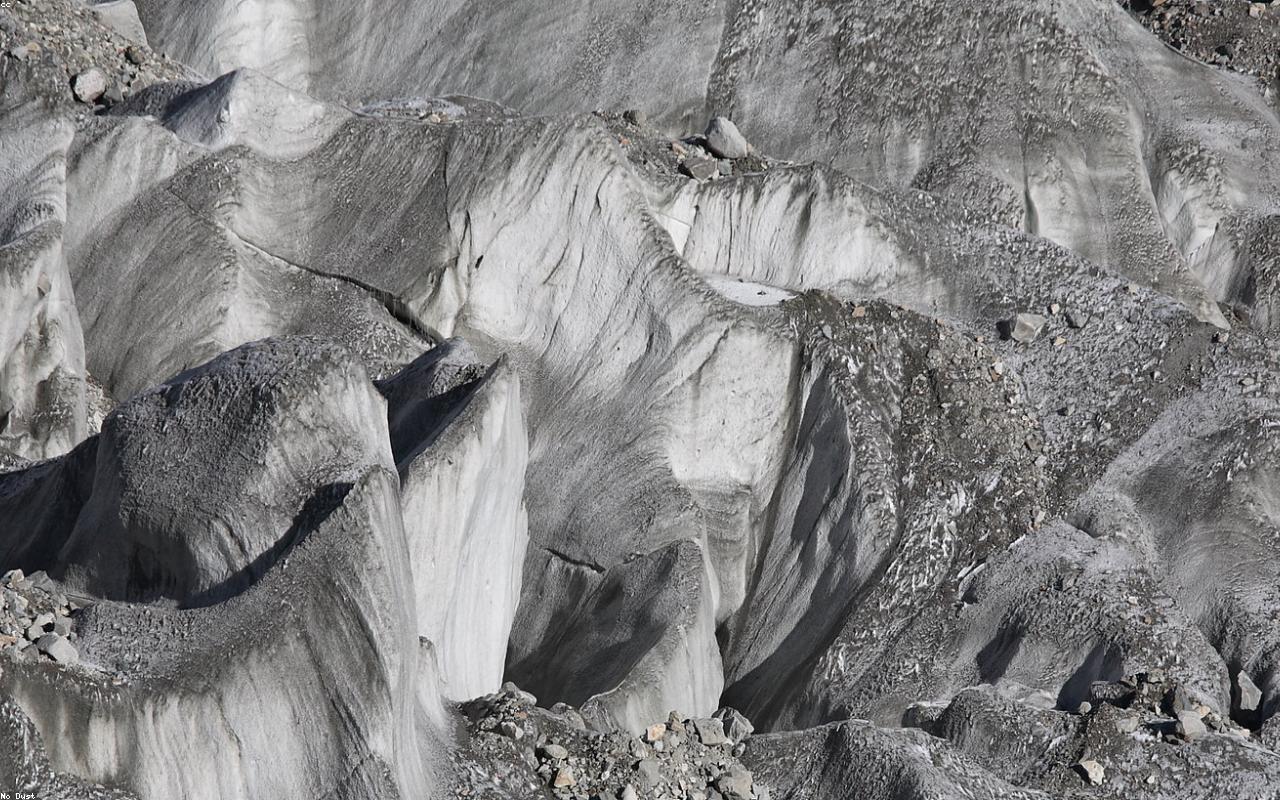
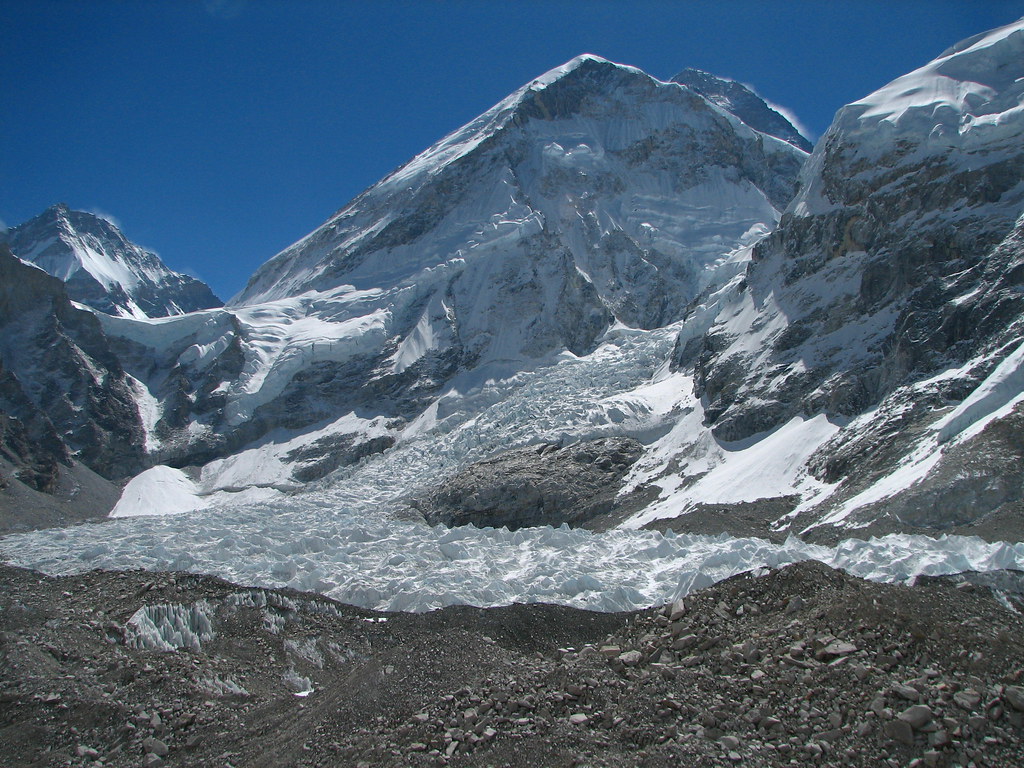
Base Camp itself sat at 5,400 metres on the Khumbu Glacier, a quarter mile below the icefall entrance. The site is still used. Standing there in October 2025, the present writer counted seventeen client expeditions already broken down, the yellow waste of their kitchen tents stacked beside the moraine. The stones Hunt's team had placed to mark mess-tent corners are gone, or buried, or simply indistinguishable from every other stone on a glacier that has moved eight hundred metres downvalley since 1953.
The route the 1953 team climbed has not substantially changed. The Khumbu Icefall is reseated each spring by the Sagarmatha Pollution Control Committee's icefall doctors, who place ladders and fixed lines roughly along the 1953 line. The Western Cwm, the Lhotse Face, the South Col, the Southeast Ridge — these are the same features. The Hillary Step, the twelve-metre rock pitch below the summit, partially collapsed in the 2015 earthquake and is now a snow ramp.
What changed is the staffing model. In 1953 the expedition was fundamentally a single party of climbers, with Sherpa support that was respected, paid, and sometimes summit-eligible. Tenzing's place on the summit team was earned, not symbolic. By the early 1990s, Himalayan guiding had professionalised in a different direction, and the work of putting clients on the summit had become almost entirely the work of Sherpa climbers, with Western guides as supervisors.
Walter Lobsang Sherpa, now seventy-one, was eight years old in 1953 and lived in Khumjung. He remembers the expedition's return through the village. The porters carried Hunt's team down on improvised litters from Pheriche, he said, because they were too tired to walk. They had been on the mountain for eight weeks and had lost an average of twelve kilograms each.
George Lowe, the New Zealander who cut the route up the Lhotse Face for ten days running, is sometimes called the unsung member of the team. He died in 2013. His widow keeps the ice axe he carried in their house in Ripley, Derbyshire. The pick is bent. He had used it to chop steps for forty-three days, including the day he led Hillary and Tenzing's load to the high camp at 8,500 metres.
Of the thirteen British climbers, two are still alive as of June 2026. Both have asked, through their families, that they not be interviewed about the expedition. The most recent biographer to attempt access, Mick Conefrey, accepted the request and wrote his 2012 book, Everest 1953, primarily from archives.
Those archives sit at the Royal Geographical Society in Kensington and at the Alpine Club in Charterhouse Street. The Alpine Club holds Hunt's expedition diary, written in pencil in a soft-cover notebook he carried in his inside breast pocket. The entry for 29 May 1953 is four lines long. It reads, in part, News from advance base. They are up.
It is the restraint of that entry that most strikes the modern reader. The expedition's official account, The Ascent of Everest, runs to three hundred and thirty pages. The diary, written in real time by the man in command, gives the climb's defining event a half-inch of space.
There is a corresponding restraint in Tenzing's own account, dictated to James Ramsey Ullman and published as Tiger of the Snows in 1955. Tenzing does not claim to have stood on the summit first. He does not claim to have stood on it second. He says they arrived together. The question of who set foot on the highest point is, in Tenzing's telling, a question the mountain itself did not pose.
Hillary, in High Adventure (1955) and in his later View from the Summit (1999), eventually said that he had stepped on first, with Tenzing perhaps a rope-length behind. The two men, who became close friends, never disagreed about it in conversation, only in print and only when pressed.
What the 1953 expedition demonstrated, in the cold reading of seventy-three years, is that a sufficiently large, well-organised, well-led party with adequate oxygen could climb the highest mountain in the world without losing a member. That had not previously been demonstrated. Every earlier attempt — the British expeditions of the 1920s and 1930s, the Swiss expeditions of 1952 — had returned with either the deaths of climbers or the failure to summit, or both.
The 1952 Swiss attempt is part of the 1953 story and is often elided. Raymond Lambert and Tenzing reached 8,595 metres on 28 May 1952, three hundred vertical metres below the summit. They turned back because their oxygen sets had given out and the snow was unconsolidated. Tenzing's 1953 summit attempt was, in his own telling, a continuation of the 1952 attempt, with a different rope partner and slightly better weather.
The British, in other words, climbed a mountain that the Swiss had been within an afternoon of climbing the year before, and that the Swiss had themselves climbed largely because Tenzing had shown them the way. The Joint Himalayan Committee's role was less to discover a route than to commit the resources to finish one.
None of this diminishes what Hillary and Tenzing did on that May morning. It places it. The summit photograph, with Tenzing's ice axe held overhead and the four flags — Union Jack, Nepal, India, United Nations — fluttering from its head, is a moment inside a long campaign, the campaign itself inside a longer one.
There is a memorial cairn at Base Camp now, built in 2003 for the fiftieth anniversary. It carries the names of Hillary, Tenzing, and Hunt, and the date. It does not carry the names of George Lowe, of Bourdillon and Evans, of the twenty-one Sherpa climbers who carried loads above 7,000 metres, or of the runners who took Morris's message down to Namche. It would not have been a small cairn if it had.