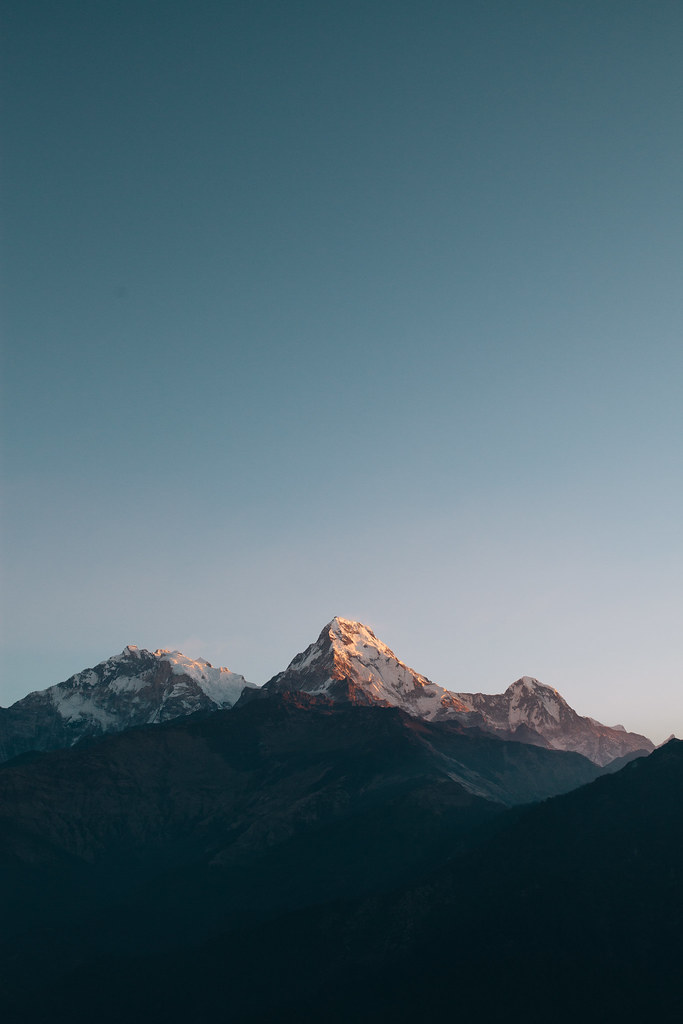
On 3 June 1950, at roughly two in the afternoon, Maurice Herzog and Louis Lachenal stood on the summit of Annapurna at 8,091 metres. They were the first humans to reach the top of any of the fourteen mountains on earth that exceed eight thousand metres. The descent took thirty-three days. By the time the expedition reached the village of Tukucha in early July, Herzog had lost all his fingers and most of his toes. Lachenal had lost all his toes.
The French expedition that put them there had arrived in Kathmandu in April 1950 with the wrong map. The Indian Survey sheet for the area, the only one available to the team, showed the wrong mountain in the wrong valley. The expedition spent its first six weeks not climbing Annapurna but looking for it. They had been authorised by the Nepalese government to attempt either Annapurna or Dhaulagiri, the two 8,000-metre peaks in the central Nepal Himalaya.
Lionel Terray, Lachenal, Gaston Rébuffat, and Herzog spent April and the first half of May reconnoitring Dhaulagiri's approaches. They found no feasible route. On 14 May, with the monsoon perhaps four weeks away, the team committed to Annapurna and moved camp. They had eighteen days to climb the mountain before the snows came.
The route they found, the north face, is still climbed and is still considered one of the more dangerous of the standard eight-thousand-metre lines. The face is exposed to serac fall from the Sickle, a hanging ice cliff at 7,200 metres. The 1950 party crossed below the Sickle four times, twice on the way up and twice on the way down, in conditions they did not fully understand.
Camp V was placed at 7,400 metres on 2 June. Herzog and Lachenal left it at six the next morning. They climbed unroped on the upper face, partly because of speed and partly because the snow conditions made a fall unlikely. They reached the summit eight hours later.
Lachenal, on the summit, said one sentence to Herzog. He said, If I go back down now, can I keep my feet? He had been aware for an hour that his feet were dying. Herzog, who has been criticised for the response, said that they had to go down regardless and that the descent would be the same speed either way. They began down within ten minutes of reaching the top.
The descent unravelled in pieces. Herzog dropped his gloves at the summit and did not retrieve them. He descended bare-handed in conditions of about minus thirty Celsius. By the time he reached Camp V, his hands were already lost. Lachenal fell two hundred metres on the upper face and was rescued by Terray, who climbed up from Camp IV in storm to find him.
The party that came down from Camp V over the following six days was four men in deteriorating condition, descending in what became the early monsoon. They spent one night in an open crevasse at 7,000 metres, having missed the camp in whiteout. Herzog, Lachenal, Terray, and Rébuffat survived the bivouac. They came out the next morning to find that the storm had buried the route below them and that they would have to navigate the descent of the Sickle by judgement alone.
The expedition doctor, Jacques Oudot, met the descending climbers at Camp II on 7 June. His treatment of their frostbite, conducted in tents and then in the porter relays down the Miristi Khola, was extraordinary. Oudot performed daily intra-arterial injections of novocaine and acetylcholine to maintain circulation in the dying tissue. He amputated Herzog's fingers, one and two joints at a time, in the porter shelters of the trek out. He worked without anaesthesia. The porters carried Herzog on a litter.
Lachenal, who could not walk, was carried for the entire month of June. His toes were amputated by Oudot at the village of Lete on 17 June. The expedition reached the railhead at Nautanwa on 6 July. Herzog and Lachenal flew from Delhi to Paris on 17 July and were admitted to the American Hospital at Neuilly, where the formal amputations were completed.
Herzog's account of the climb, Annapurna, was published in 1951 and sold roughly twelve million copies. It was for many years the best-selling mountaineering book ever published. It is also, in the modern reading, an account that has been substantially complicated by subsequent scholarship.
The principal complication is the role of Louis Lachenal. Lachenal's own diary of the expedition, suppressed by his widow during her lifetime and published in 1996 by his son under the title Carnets du vertige, gives an account that diverges sharply from Herzog's on three points. Lachenal records that he considered turning back on the summit day and that Herzog refused to discuss it. He records that the team's decisions were made unilaterally by Herzog and that the team's communication broke down on the descent. He records that Oudot's treatment was carried out without adequate consent.
Lachenal died in 1955 in a skiing accident in the Vallée Blanche above Chamonix. He had skied into a crevasse. He was forty-three. His diary remained unpublished for forty-one years.
Terray's own account, Conquistadors of the Useless (1961), is more measured than either Herzog's or Lachenal's. Terray, who was twenty-nine on Annapurna and would later make the second ascents of Makalu and Chacraraju, treats the climb as a piece of luck — luck in the route, luck in the weather window, luck in the survival of all four climbers in the descent. He died in a climbing accident in the Vercors in 1965.
Rébuffat's account, Étoiles et tempêtes (1954), is the most lyrical and the least concerned with the question of credit. Rébuffat became, in the decades after the climb, the most internationally known French climber of his generation, and the only member of the Annapurna team to have a substantial career as a writer.
Annapurna is still, in 2026, one of the more dangerous of the eight-thousand-metre peaks. The fatality rate per ascent is roughly twenty-seven percent, by the count of the Himalayan Database. By comparison, Everest's rate is roughly three percent. The mountain has killed seventy-three climbers in the seventy-six years since Herzog and Lachenal stood on the summit.
The 1950 route is no longer the standard. Most modern parties climb the French Spur, a variation that avoids the worst of the Sickle's exposure. The route Herzog and Lachenal climbed has not been repeated since the late 1990s. The Sickle has grown.
The expedition's significance is partly the climb and partly what came after. The 1950 ascent began the period that historians of mountaineering call the Eight-Thousand-Metre Era. The remaining thirteen peaks above eight thousand metres were climbed in the next fourteen years, the last being Shishapangma in 1964. The era was opened by four French climbers who came down the mountain alive, with most of their fingers and toes gone, and who carried their own ropes the last ten kilometres into Tukucha when the porters could no longer be paid.