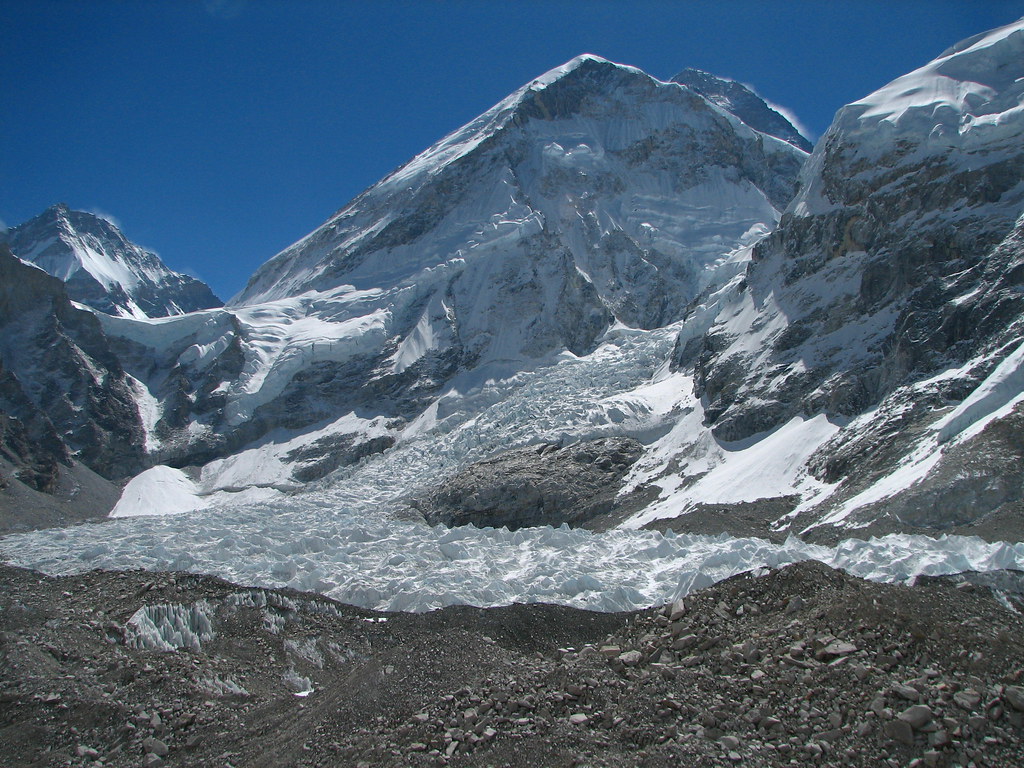
At 05:42 on the morning of April 24, 2026, a section of the western shoulder of the Khumbu Icefall collapsed. The serac involved was estimated by post-event survey at roughly four hundred metres above the route, in a band that had been monitored by the Icefall Doctors since the first carry of the season and judged stable as of the previous evening's check.
The collapse came down across the route at approximately the level of the second of the upper ladders, in a stretch of broken terrain that climbing parties typically pass in single file under the watch of a single fixed rope. The route had thirty-eight climbing Sherpas and seven Western climbers in it at the moment of the collapse, distributed along roughly a kilometre and a half of fixed line.
Six climbing Sherpas and one Western climber were in the direct fall zone. All seven were knocked off the route. Three of the Sherpas and the Western climber were buried under blocks of ice ranging in size from a refrigerator to a delivery van. Three of the Sherpas were swept clear but injured.
The rescue that followed was led by the Sherpa Mountaineering Cooperative, the body that has, since its formation in 2014, taken over the bulk of the route-fixing, load-carrying, and on-mountain rescue work on the Nepalese side of Everest. The cooperative is not technically a rescue service. It is a cooperative of working climbing Sherpas, organised for collective bargaining and shared safety standards. It has become, by default, the most experienced rescue body operating in the Khumbu Icefall.
The rescue coordinator that morning was Pemba Sherpa, forty-three, of Phortse village. He has worked on Everest for nineteen seasons and has been the cooperative's icefall rescue coordinator since 2022. He was in his tent at Base Camp eating a bowl of thukpa when the collapse came in over the radio.
Pemba paged the cooperative's standing rescue team, twenty-two climbers who had agreed at the start of the season to be available on no notice for icefall response. Twelve of them were already in the icefall, on the route ahead of or behind the collapse. The other ten were at Base Camp.
The first response was from the climbers already on the route. Within four minutes of the collapse, eleven Sherpas had reached the fall zone from above and below. They began the immediate work of locating the buried. They did not have shovels. They worked with ice axes.
The first body recovered was a Sherpa named Lhakpa Tenzing of Pangboche, who had been near the front of the carry party. He was uncovered at 06:18 and was confirmed dead at the scene by a Belgian climber, a physician named Pieter Coenen, who happened to be at the level just above the fall zone with his climbing Sherpa.
The first living recovery was a Sherpa named Ang Dorje of Khumjung, who was uncovered at 06:31 with a crushed pelvis and was conscious. He was stabilised on the route, given pain relief from the cooperative's standing icefall medical kit, and was the first casualty out of the fall zone on the second helicopter sortie of the morning.
The Western climber, an American from Boulder named Eric Trumann, age fifty-seven, was uncovered at 06:48. He was alive but had a clear head injury and was responsive only to pain. He went on the third helicopter sortie.
The Air Dynasty B3 helicopter at Base Camp was airborne at 06:09, seventeen minutes after the collapse. The pilot was a long-time Khumbu veteran named Maurizio Folini, who has flown rescues on Everest since 2008. He flew six sorties between 06:09 and 09:30, lifting casualties from a small flat platform that the cooperative cleared on the lower edge of the fall zone with the help of two Icefall Doctors.
By 09:45 all four living casualties had been evacuated to Lukla and from there to hospitals in Kathmandu. By 11:30 the three bodies had been brought to Base Camp by a combination of helicopter long-line and ground carry. By 14:00 the route through the icefall had been re-rigged on a deviation around the collapse zone by the Icefall Doctors and was, by the season's standard, operationally open again.
The cooperative held a debrief at Base Camp on the evening of April 24. The session was conducted in Nepali and Sherpa and was attended by eighty-six people, including the families of the dead who happened to be at Base Camp and representatives of every commercial expedition operating on the route that season.
The debrief identified no failure in the cooperative's response. The collapse itself was, by every assessment available, unforeseeable. The serac that came down had been on the watch list since the previous October but had shown no recent signs of motion. The Icefall Doctors had done their job. The cooperative's rescue had been as fast as such rescues can be.
The deeper question, raised in the debrief by Pemba Sherpa himself, was whether the cooperative could continue to function as the de facto rescue service of the Nepalese side of Everest in a season in which seventeen commercial expeditions had brought more than four hundred Western clients to Base Camp, each of them with a contracted ratio of climbing Sherpas on the route at all times.
The cooperative's own count of icefall transits per season has grown from roughly four thousand in 2014 to roughly eleven thousand in 2025. Each transit is a roll of the dice in a system in which the dice are weighted by season, by year, by the condition of the seracs on a given week.
The cooperative has, since the 2014 disaster in which sixteen climbing Sherpas were killed in a single serac collapse, lobbied the Nepalese government and the major expedition operators for a reduction in the number of icefall carries required per season. It has proposed, variously, the use of long-line helicopter transport for non-emergency loads, the reduction of base-camp tonnage by a third, and the formal capping of the number of permits issued per spring season.
None of these proposals has been accepted in full. The 2026 season went ahead with the same permit numbers as 2025. The April 24 collapse was the second fatal serac event of the season. The first, on April 11, killed two climbing Sherpas in a smaller event lower in the icefall.
The families of the three Sherpas killed on April 24 were each paid, by the combined contributions of their respective expedition operators and the cooperative's relief fund, sums equivalent to roughly fifteen years of average expedition wages. This is the standard the cooperative has negotiated since 2014. It is, by the cooperative's own admission, less than the work is worth and more than any other system in the high-altitude commercial climbing industry has offered.
Eric Trumann was discharged from a Kathmandu hospital on May 6 with a lasting cognitive deficit that, his family has said in a statement, is likely to be permanent. He has not returned to climbing. He has, through his family, made a gift of twenty-two thousand dollars to the cooperative's relief fund.
Pemba Sherpa, asked at Base Camp on April 27 whether he would be at the icefall again on April 25, said that he had been at the icefall again on April 25. There were carries to be made. The season continues, he said, because the season continues. The work is the work.