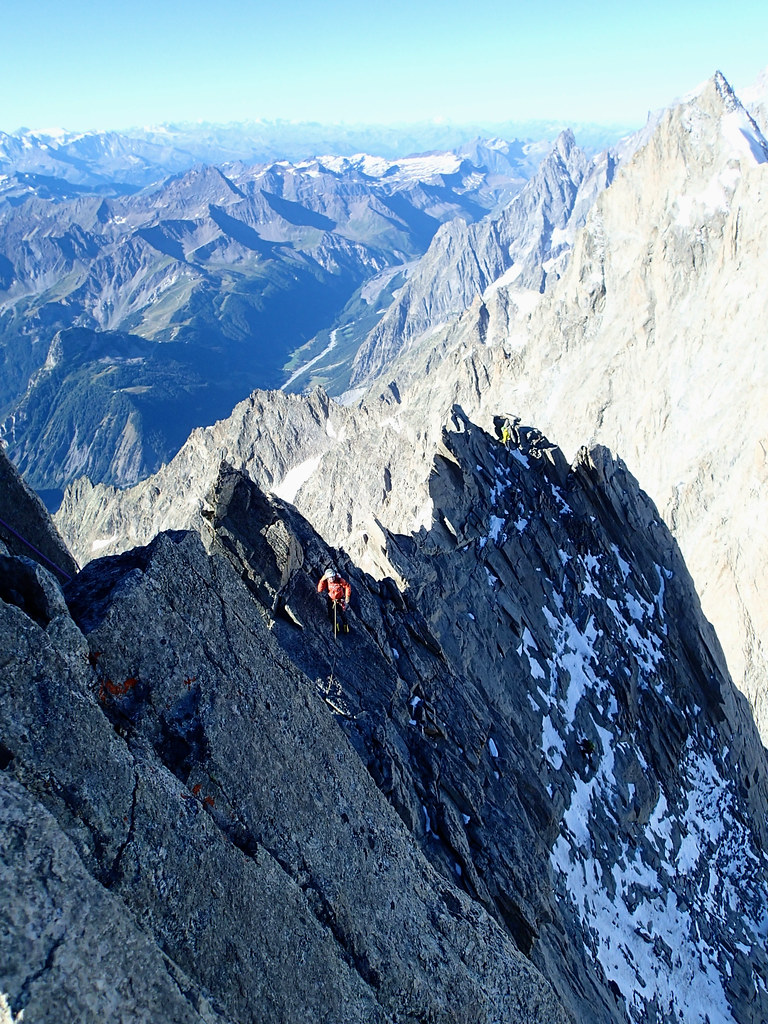
The two climbers on the second band of the Walker Spur on the morning of May 19, 2026 were Théo Pasquier, twenty-eight, and Margaux Bellecour, thirty-one, both of Chamonix and both on their second attempt at the route. Their first attempt, in September 2024, had ended at the same point, in better weather, with a decision to descend.
They had bivouacked the previous night on a small ledge at roughly 3,500 metres, on the Italian side of the spur. The forecast they had read at the Refuge Boccalatte the night before had called for a marginal day with a building system out of the southwest by mid-afternoon. They had hoped to be on the summit ridge by noon and on the descent of the Rochefort by evening.
The system arrived at 09:14. By 09:30 they were in driving snow. By 10:00 the wind on the spur was gusting to ninety kilometres an hour. They placed two cams and a nut in a crack at the back of a small alcove on the second band, clipped themselves in, and began the process of waiting.
Pasquier's mobile, in a chest pocket against his thermal layer, had two bars of signal. He called the Soccorso Alpino Valdostano dispatch number at 10:42. The dispatcher, a woman named Federica Stevenin who has been at the desk in Aosta since 2011, took the call in French. She is from the village of Étroubles and speaks both languages at near-native fluency. She kept Pasquier on the line for nineteen minutes.
The Soccorso Alpino Valdostano is the rescue service of the Aosta Valley. It is part of the broader Italian Corpo Nazionale Soccorso Alpino e Speleologico but operates with considerable regional autonomy. It is based at the regional headquarters in Saint-Christophe, just outside Aosta, and works in close coordination with the Air Service of the regional government, which operates two Airbus H145 helicopters out of the Aosta valley floor.
The duty pilot that morning was Christian Bovet, fifty-two, a veteran of the service with over seven thousand hours of mountain flight time. The duty winchman was Marco Pellissier, forty-one, a guide and rescue technician who has been on the team since 2008. The duty doctor was Anna Ravelli, a thirty-four-year-old anaesthesiologist from Pavia who had moved to Aosta in 2023 to take the position.
The team was in the air at 11:08, with the helicopter on a holding pattern over the Val Ferret while Bovet read the weather. The window between the first system and a heavier second system, by the forecast Bovet was reading on his cockpit screen, was perhaps four hours. The wind on the south side of the Grandes Jorasses was thirty knots, gusting forty-five. It was, by Bovet's later assessment, exactly at the operational margin of the H145 in mountain hover.
The first attempt to reach the casualties was made at 11:34. Bovet brought the helicopter to within sixty metres of the wall at the level of the second band, hovered for thirty seconds while Pellissier prepared the long-line, and then pulled off because of a downdraft on the lee side of the spur that pushed the helicopter sideways by a margin Bovet was not willing to accept.
The second attempt was made from a different angle at 11:51. This time Bovet approached from below, with the wind on the helicopter's nose, and held a hover at forty metres below the alcove. Pellissier descended on a thirty-metre long-line, swung once on the cable to align with the alcove, and made contact with Pasquier on the first try.
The transfer of the two climbers from the alcove to the helicopter took fourteen minutes. Pellissier first transferred Bellecour, who was the more hypothermic of the two. He clipped her into a harness that he wore on his front for exactly this purpose, signalled to Bovet, and was winched back to the helicopter with Bellecour clipped in front of him. The helicopter then withdrew to a holding position above the Val Ferret while Ravelli began rewarming.
Pellissier returned for Pasquier at 12:23. The same procedure was followed. By 12:41 both climbers were inside the helicopter and the helicopter was on its way to the regional hospital at Aosta. They were on the wall, in total, for two hours and twenty-seven minutes from the time of Pasquier's first call.
Bellecour was treated for moderate hypothermia and released after thirty-six hours. Pasquier was treated for moderate hypothermia and a frost injury to his left thumb, which he eventually retained in full. They were discharged together on the afternoon of May 21.
The second weather system arrived over the Grandes Jorasses at 14:30 on the afternoon of May 19, about ninety minutes after Bovet landed. By 16:00 the wind on the spur was gusting to a hundred and twenty kilometres an hour. The Air Service helicopters were grounded for the rest of the day and most of the following morning.
The Soccorso Alpino Valdostano performs roughly four hundred rescues a year. About a third of those involve hikers, a third involve skiers, and a third involve technical climbers. The Grandes Jorasses and the Mont Blanc massif more generally account for perhaps fifty calls a year on the Italian side alone. The French side, served from Chamonix by the PGHM and the Sécurité Civile, accounts for more.
The integration between the Italian and French rescue services on the Mont Blanc massif is, by international rescue standards, unusually good. The two services maintain a shared radio frequency, a shared mapping protocol, and an annual joint exercise in May. The 2026 joint exercise was scheduled for May 21, two days after the Walker Spur rescue. It was postponed, and went ahead on May 28 instead.
Pasquier and Bellecour have not yet announced whether they will return to the Walker Spur. They have, in a letter to the Soccorso Alpino Valdostano newsletter, thanked the team and noted that they intend to send their winter contribution to the service's volunteer support fund this December.
Bovet, asked at the heliport the following week whether the window between the systems was as tight as it had felt at the time, said that it had been about ten minutes tighter than he would have liked. He had landed, he said, with twenty-eight minutes to spare. He had been hoping for forty. Mountain weather, he added, does not negotiate.