On 24 July 2026 at 02:40, Anders Hoffmann and a client from Munich left the Boccalatte hut on the south side of the Grandes Jorasses and walked west under headlamp toward the moraine that leads to the base of the Walker Spur.
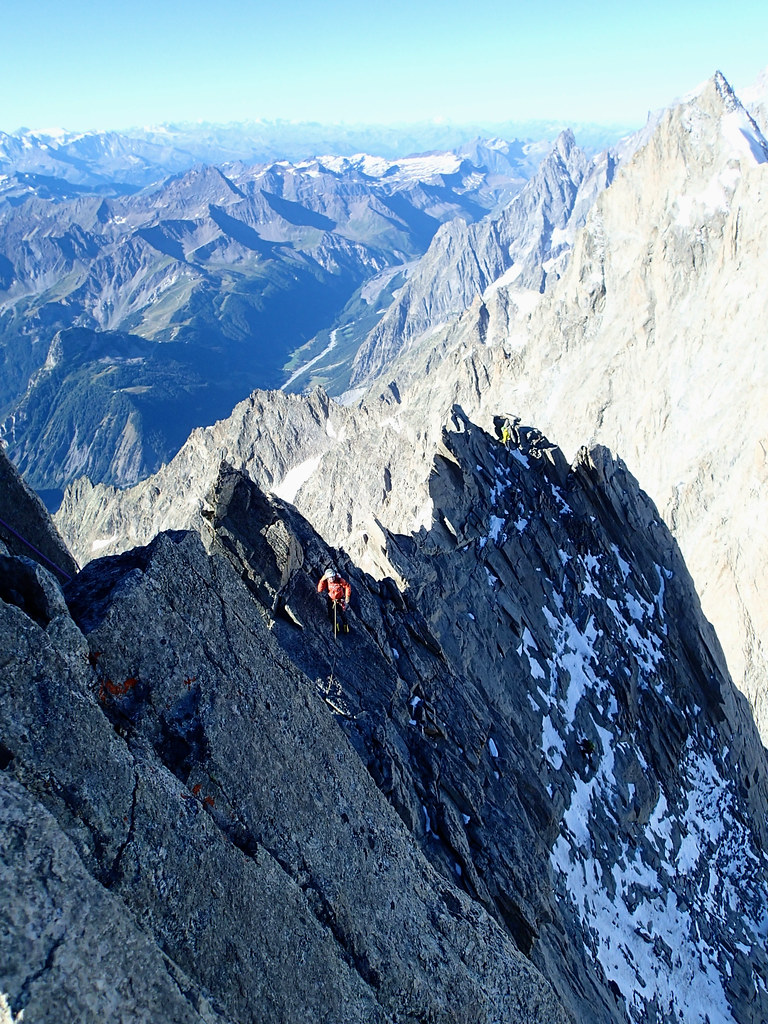
The Walker is the eastern of the two great pillars on the Jorasses north face. It was first climbed in August 1938 by Riccardo Cassin, Gino Esposito, and Ugo Tizzoni, in a three-day push that ended on the summit at twilight.
It remains, almost ninety years later, one of the routes that defines what an alpine grade VI line should feel like. There is no single hard pitch. There are forty hard pitches stacked on each other for 1,200 vertical metres.
Hoffmann's party reached the bergschrund at 04:55. The schrund crossed clean on a snow bridge that had survived the recent warm spell because the upper face had thrown debris that kept it cold.
The first 200 metres of the spur are easy mixed terrain, soloable for a confident party. They simul-climbed through the lower slabs and reached the base of the so-called Rebuffat dièdre at 06:20, just as the sun touched the summit of the Petit Jorasses across the cwm.
A note on the topo. Most modern descriptions of the Walker rely on the Piola and Steiner guidebook of 1991, updated in 2015. The pitch counts vary depending on how a party links the simpler sections.
Hoffmann uses a 23-pitch breakdown, which is what an IFMGA aspirant in Chamonix is expected to memorise. The crux pitches are the 75-metre grey slab at pitch 11 and the overhanging Rebuffat crack at pitch 15.
By 09:10 they were at the base of the grey slab. The rock here is the famous Mont Blanc protogine, a coarse granite with crystals the size of a thumbnail, that takes friction better than almost any rock in the range.
The slab went at the guidebook V+. Hoffmann placed three pieces in 30 metres and reached a thin ledge under a roof that the topo marks with a small arrow.
His client followed clean. They had agreed before the route that any fall on lead would mean retreat from the next rappel anchor, which is the way an honest day on the Walker should be climbed.
The middle third of the spur, from the grey slab to the great gendarme at half-height, is the section that makes or breaks a party's time. The pitches are uniformly mid-V, with good gear, but the climbing is intricate and route-finding errors cost twenty minutes each.
Hoffmann had climbed the line eleven times since 2009 and the route-finding came back to him in the way old routes do, as a sequence of small visual cues rather than a memorised pitch list.
At 14:20 they reached the bivouac ledge at the base of the upper headwall. Two French climbers were already there, drying their socks on a slab, having bivvied the previous night after a slow ascent of the lower spur.
The two parties exchanged a brief weather report. The Chamonix forecast had called for afternoon convection above 3,500 metres after 16:00, which gave Hoffmann's party perhaps ninety minutes of comfortable climbing before the cloud built.
The upper headwall is steeper and exposed but technically easier than the middle third. The rock is featured and the gear is generous. Hoffmann led the final five pitches without pause and topped out at 17:05.
The summit of the Pointe Walker is a small platform of broken granite at 4,208 metres, with a brass cross set into a cairn. The view south, into the Val Ferret, was already obscured by the afternoon cloud the forecast had promised.
The descent went down the Italian side via the Rocher du Reposoir and the Grandes Jorasses ridge to the Boccalatte hut. It took four hours and involved one short rappel from a fixed sling that Hoffmann replaced with new tat.
They reached the hut at 21:20. The warden, Federico Pellizzari, had kept a plate of polenta and venison stew warm in the corner of the kitchen, which is the small honour the Boccalatte extends to parties down off the north face after dark.
What the Walker teaches, Hoffmann said the next morning over coffee, is not endurance and not technical climbing. It is the discipline of moving at a sustainable pace on terrain that never lets you rest.
The route is not, in 2026, a test piece. There are harder lines in Patagonia and in the Karakoram and on the granite walls of British Columbia. But the Walker remains the line a European alpinist climbs to understand what their grandfather climbed.
Hoffmann's client, a 38-year-old engineer who had spent two years preparing for the route, did not speak much over breakfast. He paid the hut bill, shook the warden's hand, and walked down the moraine path toward Planpincieux.
The Walker had given him what it gives every party that finishes it in good style, which is the small private knowledge that the route had not been a gift, and had not been an accident.