On 5 June 2026 at 04:50, Anders Hoffmann and a 32-year-old client from Hamburg left the Albert Premier hut at 2,702 metres in the Mont Blanc range and started up the moraine path toward the Glacier du Tour.
The Aiguille du Tour is a 3,540-metre granite summit at the head of the Trient Glacier, on the border between France and Switzerland. It was first climbed in 1864 by Adolphus Warburton Moore and the guide Jakob Anderegg.
The south ridge of the peak is the route most often chosen by Chamonix guides for a client's first alpine summit. It involves an easy glacier approach, a moderate snow couloir, and a short rock ridge to the top.
Hoffmann has taken perhaps 120 clients up the south ridge since he qualified as an aspirant guide in 2009. He still finds the route worth climbing.
His client that morning was a software engineer who had spent three years climbing in the Frankenjura and one season of mountaineering in the Allgäu, and who had asked his guide service for the gentlest possible introduction to a real alpine summit.
They roped up at the edge of the glacier at 05:20, put on crampons, and walked west across the glacier toward the Col du Tour. The route across the glacier is well-trodden in June and crevasse danger is moderate but real.
Hoffmann short-roped his client across the glacier with three metres of rope between them, the standard guide's technique for moderate glacier travel.
They reached the Col du Tour at 06:40. The col sits at 3,288 metres and offers the first view down into the Trient Glacier basin on the Swiss side, with the Plateau du Trient stretching east toward the Aiguille du Chardonnet.
From the col they turned south and climbed a moderate snow slope to the base of the south ridge. The slope was in good early-morning condition, with refrozen surface that took crampon points cleanly.
The base of the south ridge is at 3,400 metres, marked by a small platform of broken granite that is the standard spot for parties to transition from crampons to rock shoes or approach shoes.
Hoffmann's client kept his crampons on. The rock of the south ridge is broken enough that crampons work as well as rock shoes for most of the climbing, and the transition saves perhaps fifteen minutes.
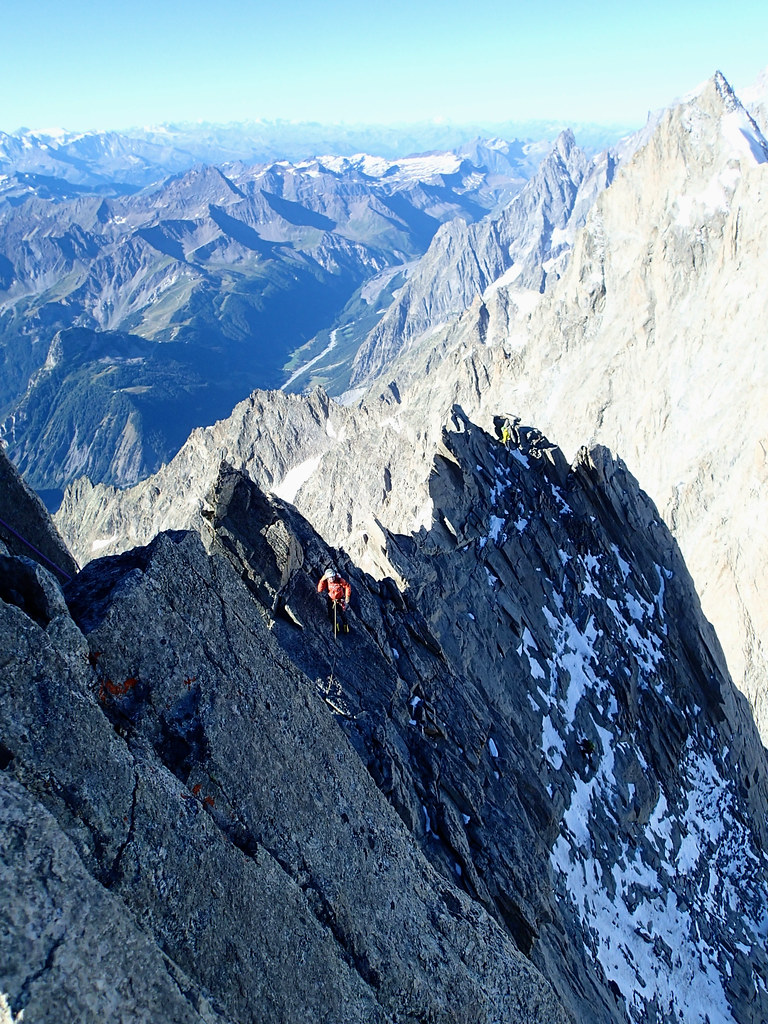
The ridge itself is 140 metres of mostly grade III scrambling with two short grade IV steps. Hoffmann placed two slings on convenient horns and used a moving belay for the rest of the climbing.
His client had not climbed alpine ridge terrain before. Hoffmann gave him brief instructions at each step: which hold to use, where to place his feet, which direction to face during the small downclimb between the second and third gendarmes.
They reached the summit at 08:25. The summit of the Aiguille du Tour is two small points of granite, the higher of which is marked by an iron cross set into the rock in 1898.
The view from the summit covered the Trient Plateau to the east, the Aiguille Verte across the Argentière basin to the south, and the long ridge of the Aiguilles Dorées running west toward the Swiss side.
Hoffmann's client did not say anything for several minutes. He sat on the summit rocks, looked at the Mont Blanc massif across the basin, and accepted a piece of dark chocolate from the small bag Hoffmann always carries.
They descended the same route in roughly half the ascent time, rappelling the two short grade IV steps with a 30-metre half rope from fixed slings, and reaching the Albert Premier hut at 11:35.
The hut warden, Élise Bichat, had reserved a plate of pasta for them and a small carafe of red wine, which is the customary welcome the Albert Premier offers parties returning from the Tour.
What the south ridge of the Aiguille du Tour offers a beginner, Hoffmann said over the pasta, is the full sequence of an alpine climb at the gentlest grade the Mont Blanc range provides.
A glacier crossing with crevasse risk, a snow couloir at moderate angle, a short rock ridge with two pitches of moderate climbing, a real summit at over 3,500 metres, a rappel descent, a return to a working alpine hut.
The route does not give a beginner the experience of difficulty. What it gives is the sequence, and the sequence is what alpine climbing is.
Climbers who want difficulty go to the harder routes after they have understood the sequence. Climbers who do not understand the sequence will hurt themselves on the harder routes, no matter how much they can climb on a bolted wall in Saxony.
Hoffmann's client paid the guide bill at the hut counter, shook Hoffmann's hand, and walked down the moraine path toward Le Tour. He had agreed, before leaving Hamburg, that he would return next summer to attempt the Aiguille du Chardonnet, which is the next step in a Chamonix guide's progression.