On 28 May 2026 at 03:15, Rinpo Tsering and a guest from Berkeley left the Whitney Portal trailhead at 2,550 metres, walked the North Fork of Lone Pine Creek by headlamp, and started up the Ebersbacher Ledges toward Lower Boy Scout Lake.
The East Buttress of Mount Whitney was first climbed in 1937 by Glen Dawson, Muir Dawson, Richard Jones, and Howard Koster. It runs 450 metres up the east face of the highest mountain in the contiguous United States and is graded III 5.7 in the Sierra system.
It is, in the long memory of American climbing, the rock route that introduced two generations of Californians to high-altitude granite. It is climbed almost every summer day from June through September.
Tsering is more often found in the Khumbu, where he has guided since 2002, but he keeps his American licence current and works two weeks each year in the Sierra for an Inyo County guide service.
His guest that morning was a 44-year-old physician who had climbed the East Buttress once before, in 2018, and wanted to repeat it as a car-to-car day to mark his return to climbing after a shoulder reconstruction.
They reached Iceberg Lake at 3,890 metres at 07:40, after a long approach on snow above Upper Boy Scout Lake. The North Fork is the standard climber's approach and the trail is well-established, but in late May there is still consolidated snow above 3,600 metres.
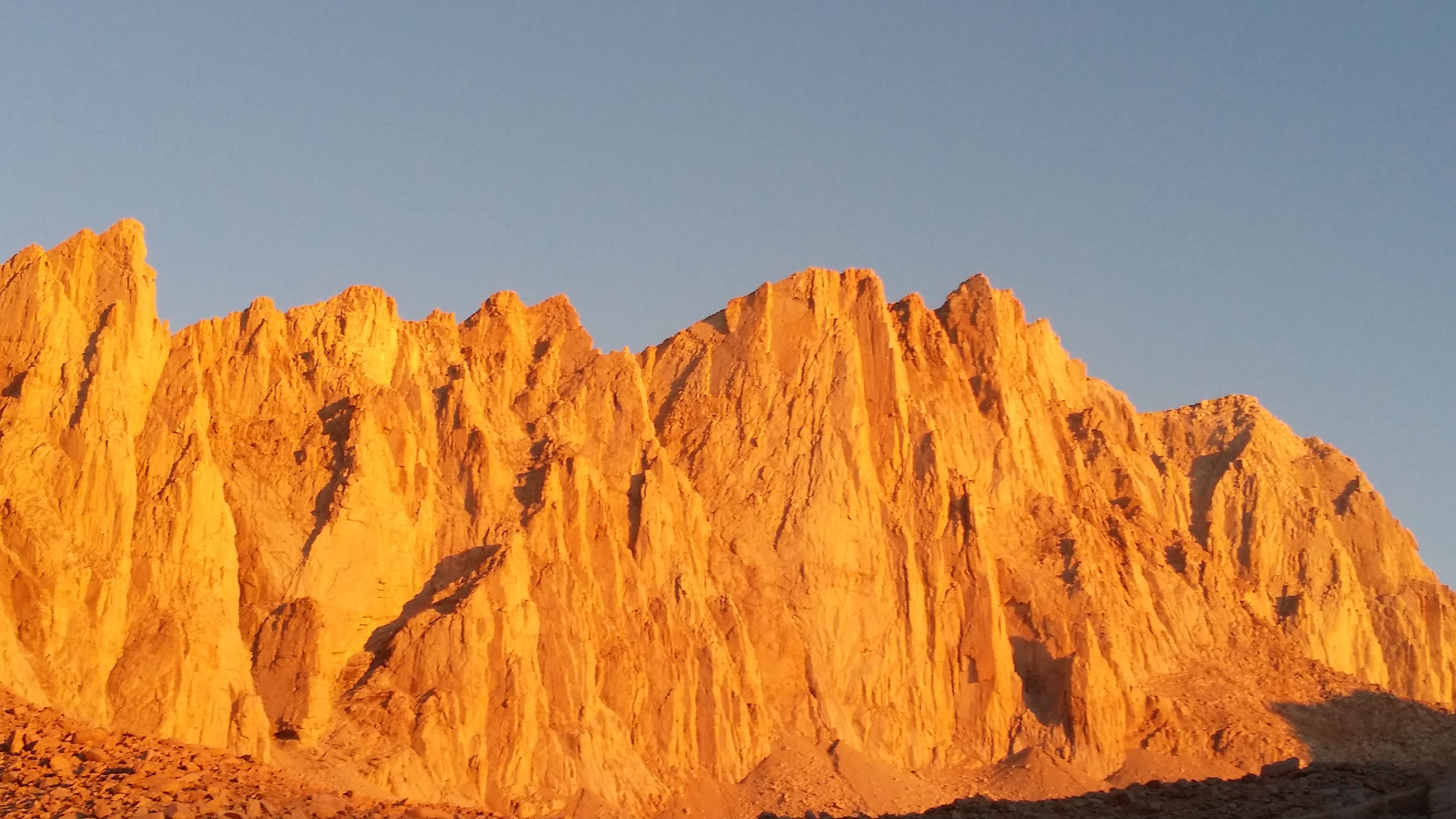
From Iceberg Lake the East Buttress rises directly above as a slab-and-corner system that ends on the summit plateau of Whitney at 4,420 metres. The line is obvious from the lake and the first pitch starts from a snow ramp at the base.
They kicked steps up the ramp in approach shoes, switched to rock shoes at a small platform at the base of pitch one, and roped up at 08:55.
Pitch one is a 40-metre 5.6 crack that leads to a small ledge. Tsering led it in eighteen minutes and brought his guest up clean. The granite of the East Buttress is fine-grained Sierra batholith, well-featured, with positive holds.
Pitches two and three are easier, mostly 5.4 ramps with one short 5.6 step at the top of pitch three. They simul-climbed these to save time and reached the base of the route's distinctive pitch four at 10:20.
Pitch four is the so-called Peewee, a 35-metre 5.7 hand crack on the right side of a clean grey wall. It is the photograph that every account of the East Buttress includes.
Tsering led the Peewee in twenty-two minutes, placing five cams in the crack. His guest followed clean, having climbed at the same grade many times before his injury.
The middle pitches of the East Buttress are a long sequence of fifth-class slabs and short corners, none harder than 5.6, with route-finding the main difficulty. The guidebook describes ten pitches but most parties simul-climb sections and reach the top in seven or eight roped lengths.
By 13:40 they were at the base of the so-called summit headwall, the final 60 metres of the route, which goes at 5.7 and tops out directly on the summit plateau.
Tsering led the headwall in two pitches, brought his guest up, and they walked the final fifty metres of broken slab to the summit of Mount Whitney at 14:55.
The summit was empty. May is shoulder season on Whitney, before the trail crowds and after the winter climbers have finished. They sat on the summit rocks for twenty minutes, drank from a thermos of black tea, and signed the summit register.
The descent went down the Mount Whitney Trail, the standard hiking route, which loses 1,800 metres of elevation across 18 kilometres of switchbacks and snow patches.
They reached Whitney Portal at 21:35, eighteen hours and twenty minutes after leaving. The Portal store had closed at 18:00 but the parking lot pay phone still worked and Tsering's guest called his wife in Berkeley to confirm safe return.
What the East Buttress teaches American climbers, Tsering said over breakfast the next morning at the Mt. Whitney Restaurant in Lone Pine, is the discipline of car-to-car climbing on a long alpine route.
The route itself is not technically difficult by modern standards. There are 5.13 sport climbers who would float every pitch on top-rope. But the route is long, the altitude affects most parties, and the descent is psychologically harder than the climb.
Climbers who underestimate the descent often run out of water on the trail and reach the Portal in poor condition. Tsering carries two litres for the route and one litre cached at Mirror Lake for the descent, which is a standard guide's load.
His guest, the physician, paid the guide bill at the restaurant counter and walked out into the early morning sun toward his rental car. He had completed the route he had set out to complete, which is what the East Buttress, in good conditions and with a good partner, will give a competent climber on a long Sierra day.