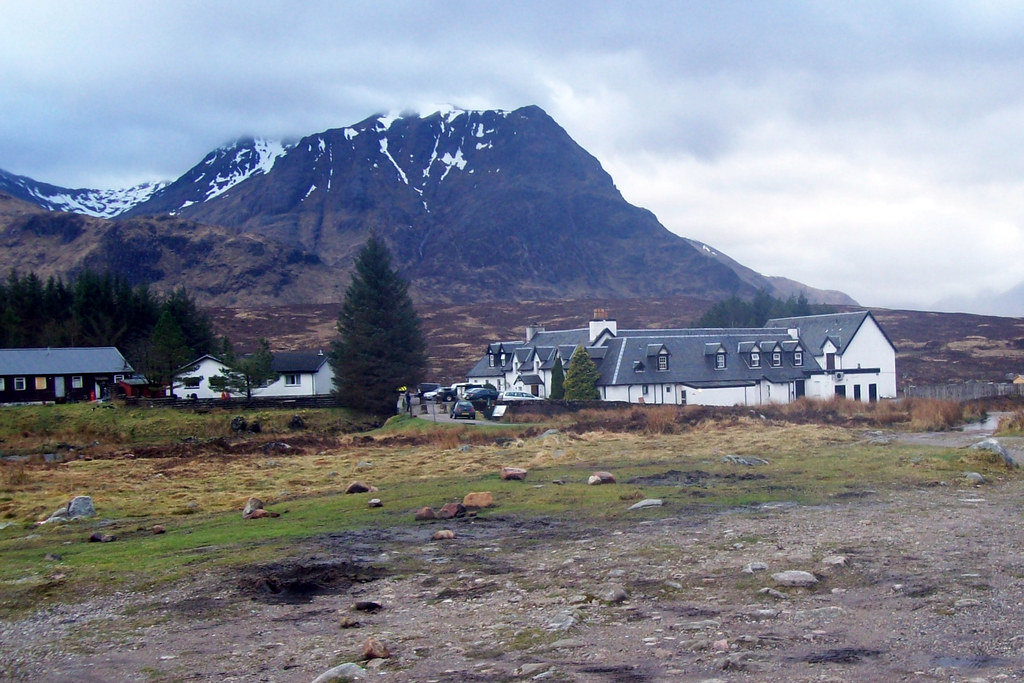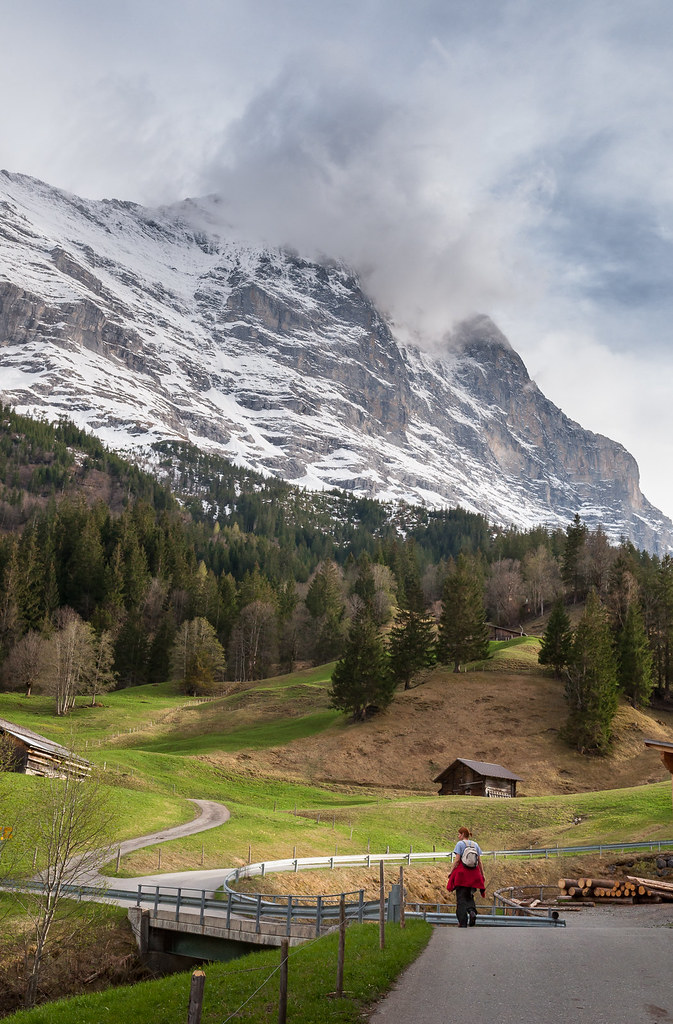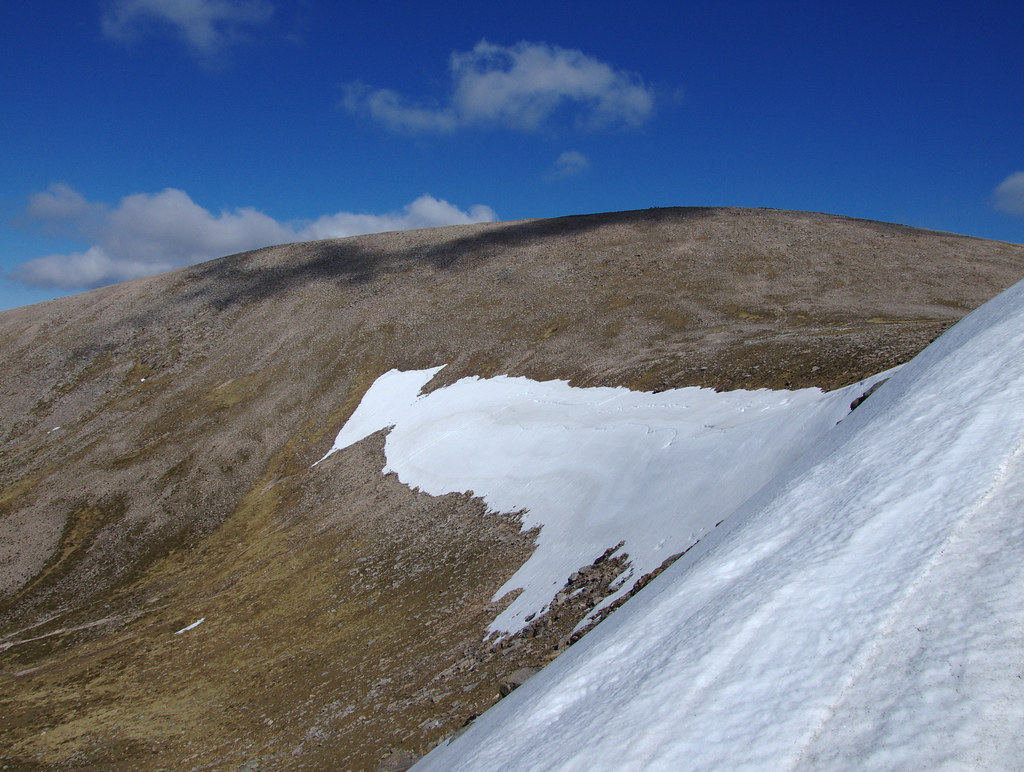
It is a clear morning in late April when Eilidh Mackinnon walks Henrik Solberg into the upper basin of Coire an t-Sneachda. The snow is mostly gone, the ground is dry-pebble at the corrie's mouth and damp at the lip, and the route is the standard summer walker's line up Goat Track Gully and onto the plateau.
Two years ago, on the night of February 9, 2024, this walk took her thirty-one hours and the help of three other teams. The casualty, an Aberdeen mountaineer named Ross Galbraith, was on the plateau in white-out conditions with a broken femur. He had been alone.
Mackinnon is the deputy team leader of Cairngorm Mountain Rescue Team. She has been on the team since 2008 and is, in her professional life, a primary school teacher in Aviemore. She stops at the foot of Aladdin's Couloir, points up and to the right at a low spur of granite below the cornice line, and says that is where they spent six hours on the night of the rescue trying to find him.
Galbraith had set out alone from Glenmore at 06:30 that Friday. His plan, posted to a mountaineering forum the night before, was a circuit of the Cairngorm plateau via the Goat Track, Cairn Lochan, the Ciste Mhearad, and a descent down Fiacaill a' Choire Chais. He had crampons, an ice axe, a winter shell, and a Garmin InReach. The Mountain Weather Information Service forecast for the plateau that day called for poor visibility, wind speeds gusting to seventy miles per hour from the south, and the possibility of full white-out by midday.
He went anyway. At 11:48, near the top of the Goat Track, he stepped onto a section of windslab that broke under him. He slid roughly forty metres down the upper corrie, came to rest against a granite buttress, and broke his right femur in two places.
He triggered the InReach at 11:53. Cairngorm MRT was paged at 12:09. By 13:10 the team's first hasty party of four was leaving the cafe at the Coire Cas car park, walking into a wind that the team's later log recorded as seventy-eight miles per hour at the lip of the corrie. Visibility was perhaps fifteen metres.
The InReach gave a position to within ten metres. The problem was finding that position in conditions in which a team member at the rear of a four-person rope could not see a team member at the front. The hasty party reached the lip of the corrie at 14:40, traversed east along the rim for forty minutes searching with handheld GPS, and could not locate the casualty.
Mackinnon, who was on the hasty party that day, says now that they walked across him twice. They were less than thirty metres from where he was lying, but in white-out the granite buttress that sheltered him was invisible, and Galbraith himself was already half-covered in spindrift.
By 16:00, with the light going, the team called for support. Braemar MRT and Aberdeen MRT both committed parties. The Coastguard helicopter at Inverness was grounded by the wind. The RAF Lossiemouth Sea King, which had been retired in 2016 anyway, did not exist as an option.
The find came at 17:48, in near-total darkness, when a Braemar team member named Calum Forsyth tripped over Galbraith's left boot. Galbraith was conscious, hypothermic, and according to Forsyth's later account swearing fluently in Doric.
What followed was a six-hour stabilisation on the plateau and a fourteen-hour stretcher carry down the Goat Track to the corrie floor, and then out along the standard walker's path to the car park. The team rotated through four stretcher crews. Mackinnon was on the last one, taking the foot of the stretcher from 04:00 to 06:30 on Saturday morning.
Galbraith reached Raigmore Hospital in Inverness at 09:11 on Saturday, February 10, 2024, almost twenty-two hours after he had broken his leg. The femur was pinned that afternoon. He spent six weeks in hospital and a further four months in physical therapy. He walked again by the autumn. He has not been back on the Cairngorm plateau in winter.
Walking the route in April, two years on, Mackinnon stops at several points to mark what the team did at each. The buttress where Galbraith was found. The notch on the corrie rim where the hasty party first turned east. The flat granite slab on the descent where they switched stretcher teams for the third time. None of it is marked in any visible way. It is only marked in the team's memory and in the after-action log.
The Cairngorm MRT after-action review of the call-out, conducted on February 20, 2024, identified three issues. The first was the difficulty of locating a casualty by GPS in zero visibility against a featureless snowfield. The second was the absence of any helicopter support. The third was a team fatigue issue, in which the original hasty party had been on the hill for twenty-six hours by the time they came off it.
The team's response to the first issue was a series of practice exercises in 2024 and 2025 on white-out navigation and casualty location, including the use of avalanche transceivers as a casualty marker in low-visibility situations. The team now carries spare transceivers to deploy on casualties who have made contact via InReach but cannot be located visually.
The response to the third issue, the fatigue issue, was a stricter rotation policy. Any team member on the hill for more than twelve continuous hours is now stood down at the next available rotation point. Mackinnon admits this is the rule honoured most in the breach.
The Cairngorm team responded to ninety-four call-outs in 2025. The 2024 Galbraith rescue is, by a clear margin, the longest single job in the team's recent history. It is the call-out the team trains for and the call-out the team hopes not to do again.
Galbraith, who lives in Aberdeen and still climbs, agreed to be interviewed for this piece on the condition that he be allowed to say in print that he should not have gone out that day. The forecast was clear. He read it. He thought it would be all right. The team brought him home. He owes them, in his words, the rest of his life.
Mackinnon, asked at the corrie mouth in April whether Galbraith's gratitude makes the long nights easier, says it does. She also says that what makes them easier is that, two years on, she can walk this corrie in spring light and watch the snow buntings on the lip, and know that the buttress that hid him for six hours is still there, exactly where it was, doing nothing in particular, in the sun.