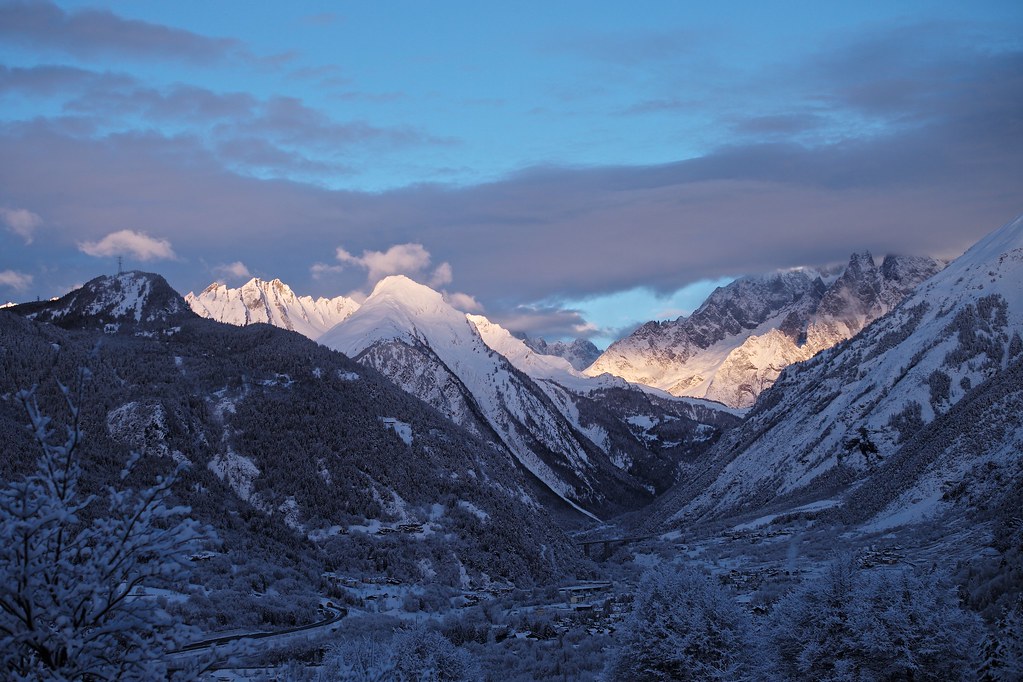
At 11:20 on the morning of 18 May 2026, in a small office above a pharmacy on the via Roma in Courmayeur, Caterina Bovet was filling out the paperwork required to renew her insurance for the coming summer season.
She is forty-three, an Aosta Valley native, and the third woman in history to be admitted to the Società delle Guide di Courmayeur, the alpine guide society that has operated continuously in this valley since 1850. She was admitted in 2017, ten years after the first woman, Federica Mingolla, joined the equivalent society at Cervinia.
The valley's guide trade is, by any reasonable measure, the oldest organised mountain-guiding profession on the planet. The Compagnie des Guides de Chamonix, on the French side, was founded in 1821. The Courmayeur society followed in 1850. The Cervinia society in 1865. The membership, for the first one hundred and fifty years of each, was exclusively male.
The exclusion was not, in most cases, formal. The societies did not, in their bylaws, prohibit women. They did not need to. The pathways to membership, which required years of apprenticeship under existing guides, were, by long social custom, closed to women in a way that was so embedded in the trade's daily practice that it required no codification.
What changed, beginning in the 1980s, was first a small number of individual women on the French side and then, more slowly, on the Italian side, who simply did the work. They climbed the routes. They took the certifications. They did the aspirant years. They did them, in some cases, against the active discouragement of the existing membership.
Bovet's account of her own aspirant period, given in the office above the pharmacy on a Monday morning when she was supposed to be doing paperwork, was that the discouragement was rarely overt and almost always conveyed through a particular kind of silence. She would, she said, walk into the guides' room at the Refugio Torino and the conversation would not stop, exactly, but it would change in a way she could feel.
What helped her, she said, was not any particular ally among the older guides. It was a slightly younger generation of male guides, then in their thirties, who had grown up around women climbers in a way the older generation had not, and who treated her presence as an unremarkable fact rather than as a question to be discussed.
The second woman in the Courmayeur society was Anna Torretta, the well-known ice climber, who was admitted in 2010. The third was Bovet. The fourth was a woman named Erika Siffredi, who is now thirty-six and who was admitted in 2021. There is, as of 2026, a fifth aspirant, a woman from Pré-Saint-Didier in her late twenties whose name Bovet asked not to be published until her certification is complete.
Siffredi met Bovet for lunch on the day after Bovet's insurance paperwork. They ate at a small restaurant on the via Marconi that has been open since 1962 and that serves, for nine euros and fifty cents at lunch, a plate of polenta concia and a glass of red wine. The owner, a man named Sergio, has known Siffredi since she was eight years old.
The conversation between Siffredi and Bovet was, for some minutes, about the routine and unromantic business of the trade. The price of a Hilti drill. The reliability of a particular brand of ice screw. The new wording in the regional civil-protection guidelines for guided parties.
It turned, after the polenta, to the question of clients. Both women said, with no particular emphasis, that they were now, after years in the trade, asked to guide women clients more often than they had been when they started. This was, in their experience, partly a function of women clients seeking out women guides and partly a function of male clients who had specifically wanted a woman guide for reasons they did not always state.
Both women said that they had also, throughout their careers, guided male clients without any particular issue, and that the male clients who would have refused to be guided by a woman had largely self-selected out of their roster by the second or third season.
What had not changed, they agreed, was the question of equipment. Climbing harnesses, boots, helmets, and packs are, in the main, designed for male bodies, and the women's variants, where they exist, are designed for male bodies of slightly smaller proportions. Both women had, over the years, modified equipment in small ways to make it work for their actual bodies.
Bovet said that the most useful single item she had ever owned was a custom-fitted harness she had commissioned from a small workshop in Mendrisio in 2014. It had cost her seven hundred and forty Swiss francs at the time, and she had used it on, by her best estimate, six hundred and twenty guiding days since.
The third woman the magazine met that week was Erika Siffredi, in her own kitchen in La Salle, a small village ten kilometres down the valley from Courmayeur. She lives there with her partner, a non-guide who works as a programmer for a Turin software company, and their seven-year-old daughter.
The conversation in Siffredi's kitchen returned to a question Bovet had touched on but not dwelt on, which was the question of children. Siffredi had taken her one full season off in 2018, when her daughter was born, and had returned to the trade the following spring on a reduced schedule. She had not, she said, found the trade hostile to her doing so. She had not, equally, found it particularly accommodating.
What was accommodating, in her account, was her partner, who had taken a parental leave of nine months and who, in the years since, had reorganised his own work schedule to allow her to take the high-season days she needs to make a guide's income. The trade itself, she said, had been neutral.
The Aosta Valley regional government has, since 2019, operated a small bursary scheme for women undertaking the aspirant guide certification. The bursary covers approximately a third of the direct cost of the certification's three-year sequence of courses. It has, as of 2026, supported nine women, of whom four have completed the certification, three are currently in process, and two have withdrawn.
Of the two who withdrew, one withdrew for reasons of injury and one for reasons that were not made public. The four who have completed include Siffredi, two members of other valley societies, and a woman who has since moved to Switzerland to work out of Saas-Fee.
The picture that emerges from these three guides, taken together, is not one of dramatic change. It is one of slow, particular, individual change, in which the women admitted to the Courmayeur society are now a sufficient minority that their presence is no longer remarked on by the older guides and is, by the younger ones, simply taken as a feature of the trade. Bovet, asked at the end of her insurance paperwork what she thought the society would look like in twenty years, said only that it would have more women in it, and that nobody, by then, would write articles about that fact.