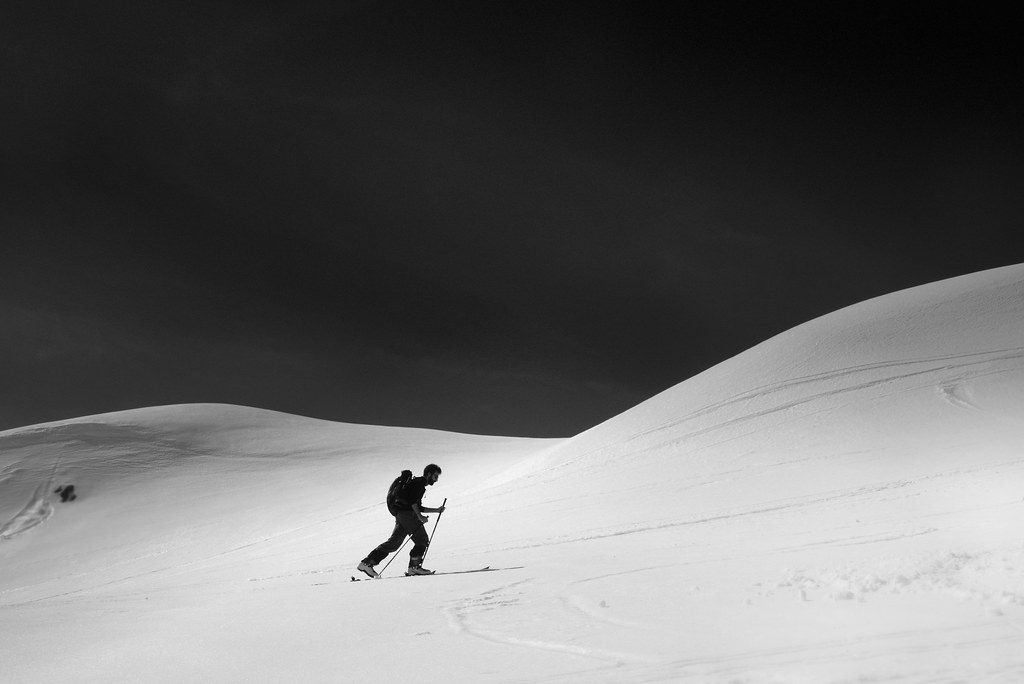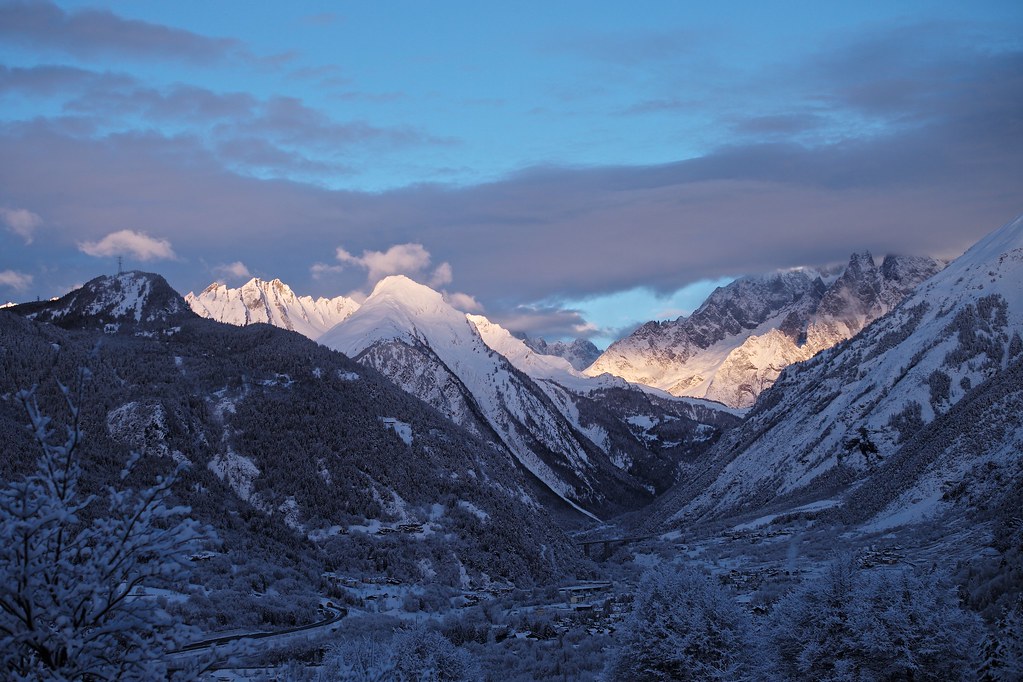
At 09:14 on the morning of 11 March 2026, Andrea Pichler stopped his rope of four clients on a south-facing slope at 2,540 metres above the Dresdner Hütte in the Stubai, took off his pack, and began to dig.
He is forty-seven, IFMGA-certified since 2009, and has been working ski-tour weeks out of the Stubai for fourteen consecutive springs. The slope he was standing on was a slope he had skied, by his own conservative estimate, perhaps four hundred times.
The clients were a German pair from Munich and an Austrian couple from Salzburg, all four of them experienced ski tourers, all four of them booked through a small Innsbruck guide service for a six-day hut-to-hut traverse. The day's objective, the third day of the trip, was a small summit at the head of the cirque, with a planned descent down the slope on which Pichler had now stopped.
What he was looking for, when he began to dig, was a confirmation of a small unease he had felt at the previous evening's avalanche bulletin. The Tyrolean avalanche service had rated the day's hazard at level two, moderate, on a scale that runs from one to five. The bulletin had noted, however, a specific concern about wind-deposited snow on south through southwest aspects above 2,200 metres.
The slope Pichler was standing on faced south-southwest and was at 2,540 metres. It was, in other words, exactly the slope the bulletin had been describing.
This is the moment, in any guide's working day, that separates the routine from the consequential. Pichler had skied this slope four hundred times. He had skied it in conditions much worse than the present one. He had not, in his fourteen years, triggered an avalanche on it or seen one triggered.
None of this was, on the morning of 11 March, relevant to the question he was being paid to answer. The question was whether the snow on the slope, that morning, in those conditions, was safe for a party of five to descend.
Pichler dug a small pit to a depth of one hundred and twenty centimetres, in a representative location forty metres above the slope's main convexity. The pit took him eleven minutes. He noted the snowpack profile in a small waterproof notebook he keeps in the chest pocket of his shell.
The profile showed, at sixty-five centimetres depth, a weak layer of faceted crystals approximately four centimetres thick, sitting on a hard old-snow crust. Above the weak layer was a recent slab of wind-deposited snow approximately forty-five centimetres thick. Below the crust the snowpack was settled and unremarkable.
This is, in textbook avalanche terms, a recipe. A weak layer of facets, sandwiched between a hard bed surface below and a denser slab above, on a south-southwest aspect that had received wind loading from the northwest over the previous two days. It is the configuration that produces, in the eastern Alps, most of the spring slab avalanches that kill people.
Pichler performed two column tests. The first failed at the weak layer with a moderate force, with a clean planar fracture. The second, performed three metres away to control for the first test's representativeness, failed at the same layer with a slightly easier force, with the same planar character.
He closed his notebook, refilled the pit with the snow he had removed, and walked back across the slope to where his clients were waiting. He told them, in German, that the snow on this slope was not safe today and that they would not be skiing it.
The clients took this news with the kind of muted disappointment that an experienced ski tourer feels when they understand the underlying logic without needing it explained. One of the Germans asked, conversationally, what Pichler had found in the pit. He told them. The German nodded.
The decision to turn around is, in the snow-science literature, often described as the most consequential single skill a guide possesses. It is also, as several practitioners have pointed out over the years, the most difficult to teach, because the teaching environment cannot replicate the social and economic pressures that make the decision, in the field, difficult to make.
The pressures, in Pichler's case that morning, were the usual ones. The clients had paid for the day. The slope had been the planned objective for two weeks. The next-best alternative, a longer and lower-angle descent on a north-facing aspect with significantly less interesting skiing, was an obvious comedown from the day's original plan. Pichler made the call anyway.
The alternative descent took the party an additional one hour and twenty minutes to ski, on snow that was, in absolute terms, less enjoyable than the snow on the south-southwest slope would have been. The clients, by the time they reached the Dresdner Hütte at 13:30, were, by their own accounts, tired and ready for lunch.
At 16:42 that afternoon, while the party was drinking coffee in the hut's main room and Pichler was reading the next day's avalanche bulletin on his phone, the south-southwest slope above the cirque released a size-two slab avalanche, approximately seventy metres wide and four hundred metres long, with a crown fracture of fifty-five centimetres.
The release was triggered, as best as the Tyrolean avalanche service could later reconstruct, by a separate party of three ski tourers, two of whom were caught and one of whom was partially buried to a depth of approximately eighty centimetres. The partial burial victim was recovered alive by his two companions within fifteen minutes, with no serious injuries.
The release happened in Pichler's clear view, from the window of the hut. He watched it without speaking, set down his coffee, and walked to the hut's radio to relay the incident to the regional rescue service. By the time he had completed the call, the rescue helicopter from Innsbruck was already inbound, having been alerted by the avalanche transceiver signal of the buried skier.
The clients, who had been watching with him, did not speak about the avalanche over dinner. They did not speak about it the following morning. They did not speak about it for the remainder of the trip. On the sixth and final day, as they were unloading their packs in the parking lot in Neustift, the Salzburg woman shook Pichler's hand and said, in the deliberate way of someone who has been preparing the sentence for several days, that she would book him again for next year.
Pichler does not, in his ordinary practice, tell this story. The version printed here was given to Mountain Ledger only after a long conversation, and only on the condition that nothing in it be presented as exceptional. The point, in his account, was not that he had made an unusual decision. The point was that he had made an ordinary decision, of the kind a working guide is paid to make on every tour day of every season, and that the value of the decision was visible that afternoon only because somebody else, on the same slope a few hours later, made the opposite one.
The day's lesson, if there is one, is not that snowpit tests predict avalanches reliably. They do not. The day's lesson is that a careful guide, on a slope they have skied four hundred times, in conditions that look ordinary, can still find the small piece of evidence that turns the day around. And that they have to keep doing this, on every slope, every day, for the entire length of a thirty-year career, because the day they stop is the day the slope finally moves.