On a Saturday morning in early May, the snow ranger station at Hermit Lake, halfway up the trail to Tuckerman Ravine on Mount Washington in New Hampshire, opens at 0700. The ranger on duty for the 9 May 2026 shift was Doreen Aikins, who has held the position, in some form, since 1995.
Aikins is 62. She is a Forest Service employee on a seasonal contract that runs from late March to early June. Her job description, condensed, is to keep skiers and climbers alive in a piece of terrain that has killed approximately one hundred and sixty-one people since records began.
Mount Washington is not a high mountain. Its summit is 1,917 metres. But it sits on the edge of the prevailing North Atlantic storm track, and it produces weather that is, by several measurements, more violent than that of mountains four times its height. The summit observatory recorded a gust of 372 km/h in 1934 that stood as the world record for sixty-two years.
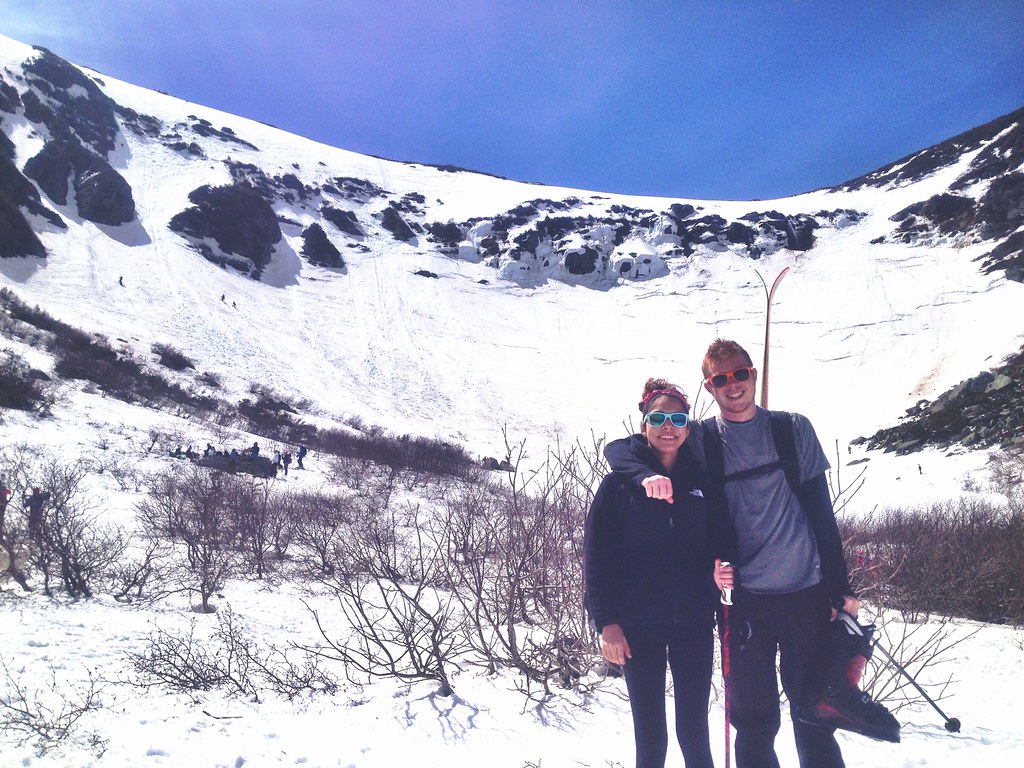
Tuckerman Ravine is a glacial cirque on the south-east face. It collects, through a process of wind-loading from the dominant westerlies, a snowpack that often exceeds nine metres at its centre. It is a popular spring ski destination because the headwall is steep, the snowpack reliable into June, and the approach, while strenuous, is non-technical.
It is also, every spring, the site of avalanches, ice falls, rock falls, falling skiers, and a steady trickle of orthopaedic injuries.
Aikins keeps a chart, posted at the Hermit Lake station, that summarises the conditions of the day. It is updated by hand at 0700, again at 1100, and again at 1400 if conditions change. The categories are slope-by-slope: Left Gully, Right Gully, Lip, Chute, Headwall, Hillman's Highway. The ratings range from 'open' through 'use caution' to 'closed.'
On 9 May, the Headwall was marked 'closed' due to an active glide crack near the upper lip. The Lip was marked 'use caution' due to falling ice in the morning warming. Left Gully was marked 'open.' Hillman's Highway was marked 'open.' The rest of the chart was blank, which Aikins explained meant she had not yet been to those slopes that morning.
She would walk to them, with her partner ranger Tomás Esquivel, in the next two hours.
Aikins does not, in any formal sense, have the authority to stop a skier from descending a closed slope. The Forest Service designates Tuckerman as a 'self-regulated' wilderness area. The chart is an advisory. The skier is the decider.
But Aikins, who is small, white-haired, and unfailingly polite, has been known to stand at the lip of the Headwall for several minutes in conversation with a hopeful skier, asking quiet, specific questions about the skier's experience, their assessment of the snow, their plan if something went wrong, and the names and telephone numbers of the people who would need to be called. The conversations are calm. They tend to end with the skier walking back down to Left Gully.
She estimates that she has had perhaps four thousand such conversations over thirty-one springs. She has, by her own count, twice failed to dissuade a skier who then died.
She does not name them when she tells the story. She gives the dates. One was 12 May 2003. The other was 1 April 2017.
The dead at Tuckerman Ravine are commemorated in a small bronze plaque at the AMC Pinkham Notch Visitor Center, at the trailhead. The plaque lists names and dates. It is updated every few years. Aikins helped revise it most recently in 2024. She does not generally read it.
The 9 May 2026 shift unfolded, as most do, in stages. By 0830 the first skiers had arrived at Hermit Lake, having walked the four kilometres from Pinkham Notch with skis on their packs. By 1000 perhaps four hundred people were in or near the ravine. By 1130 a temperature inversion that had kept the snowpack frozen overnight had broken, and the ice on the upper headwall began to release in small, audible chunks.
Aikins moved up to the bowl floor and worked through the crowd in a deliberate clockwise loop, talking to perhaps sixty people in two hours. She turned back four parties from Left Gully because of crowding above. She turned back one from Hillman's Highway because the skiers had soft snowboard boots and no helmets. She spoke at length to a group of three young men from Boston who wanted to ski the Lip, and they did not.
At 1342 a skier fell about a third of the way down Right Gully, slid two hundred metres on hard snow, and stopped in the runout with what turned out to be a fractured pelvis. Aikins reached him in eleven minutes. The rescue, conducted with the Mount Washington Volunteer Ski Patrol and a Black Hawk helicopter from the New Hampshire Army National Guard, took four hours.
The skier survived. He thanked Aikins, from the gurney at the AMC clinic that evening. She told him, evenly, that the next time he came to Tuckerman she would like him to walk through her station first.
He said he would.
The Forest Service has, in recent years, considered increasing the formal authority of the snow rangers, including the power to issue citations to skiers who descend closed slopes. The proposals have not advanced. The argument against them, made internally by Aikins and other senior rangers, is that the relationship between ranger and skier depends on a kind of voluntary trust, and that a citation book would destroy it.
The argument has prevailed, for now.
Aikins plans to retire at the end of the 2026 spring season, which closes when the snow no longer supports skiing, usually in early June. She has trained Esquivel, who is thirty-four, to take her position. She intends, after retirement, to walk up to Hermit Lake on perhaps three or four spring weekends each year, look at the chart, and not say anything about it.