On the 14th of October, the téléphérique de l'Aiguille du Midi closes for its autumn maintenance, and the rue du Docteur Paccard is quiet by four in the afternoon.
The summer alpinists left in late September, the skiers will not arrive until the second week of December, and in between the town belongs, briefly, to the people who live in it.
Madame Eliane Vibert, who has run the small épicerie at 22 rue Joseph Vallot since 1991, says she sells more bread to locals in October than in any other month. They are tired of cooking for tourists, she said in early October. Now they cook for themselves.
The hotels do not all close. Le Faucigny, on the avenue Ravanel-le-Rouge, keeps eight of its twenty-eight rooms open through the shoulder season, mostly for tradespeople doing roof work on the chalets above town before the snow comes.
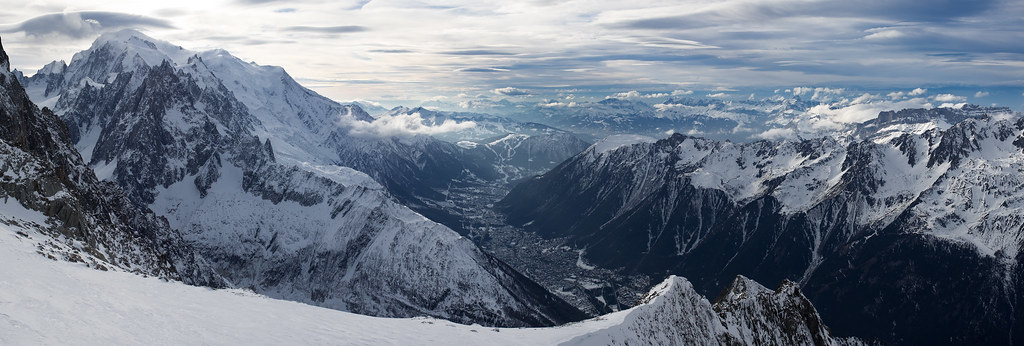
There is a particular quality to the light in the valley in October. The sun clears the Brévent ridge at half past eight in the morning and is gone behind the Aiguilles by four, and for those seven and a half hours the granite looks bronze rather than grey.
Most of the high refuges have already closed. The Refuge Albert 1er shut its doors on the 28th of September. The Refuge du Couvercle followed three days later. The Refuge des Cosmiques, perched at 3,613 m below the Aiguille du Midi, stays open year-round but is reachable in October only by helicopter or by the patient, with crampons.
Down in town, the climbing shops on the avenue Michel Croz begin their slow turnover. Snow Leopard, the small mountaineering outfitter run by Jérôme Forclaz since 2003, moves its ice tools to the front window in the first week of October. Forclaz says the changeover takes him four days. He does it alone.
The Compagnie des Guides de Chamonix, founded in 1821 and still the oldest mountain-guiding company in the world, runs a skeleton roster in October. Of its 230 active guides, perhaps forty are working in the valley at any one time. The rest are in Nepal, in Patagonia, at home with their families, or recovering from a long summer.
Anders Hoffmann, who guided here for eleven seasons before he became an editor, once described October in Chamonix as the month the valley remembers what it is. He meant that the town, stripped of its visitors, is briefly legible again — a working alpine village rather than an international resort.
On the 9th of October a thin band of snow reached down to 2,400 m overnight, and by morning the upper Argentière glacier was white above the lateral moraine. The light over Les Drus that afternoon was the colour of pewter.
Restaurants close one by one. Le Cap-Horn, on the place Balmat, served its last meal of the season on the 11th of October and will reopen on the 15th of November with a different chef. The new chef, Margaux Reuille, is twenty-eight and came up from a brasserie in Annecy.
The market on the place du Mont Blanc runs every Saturday year-round, but in October the stalls are different. The cheese-maker from Servoz, Pascal Cretton, brings only his reblochon and his small-format tomme. The vegetable vendor brings squash and the last of the leeks. There are no tourists buying lavender sachets.
At the Maison de la Montagne, the office of the guides company, a board outside lists the routes still considered in condition. On the 12th of October the board showed five: the Frendo Spur on the Aiguille du Midi (mixed, for experienced parties only), the south ridge of the Aiguille du Tour (rock, dry), the Cosmiques arête (mixed, condition variable), the Couverkle traverse (snow, requires equipment), and the Petit Mont Blanc (snow, manageable).
The board is updated daily by a rotating guide. On the 12th the duty guide was Sylvain Charletoz, who took the felt-tip pen and added, in small letters at the bottom: Vent prévu Mercredi.
By the second week of November the board will be replaced by a winter version listing avalanche risk zones rather than routes. The transition is not announced. One Saturday it is simply different.
There is a memorial in the cemetery on the avenue du Bouchet for the guides who have died on the local peaks. The list runs to several hundred names, beginning in the 1820s. On a clear October afternoon a visitor can walk the length of the memorial in perhaps ten minutes.
Lucia Marengo, who grew up an hour's drive south in the Aosta Valley, has been visiting Chamonix in shoulder season since she was a child. She remembers her father bringing her here in October to buy ice screws because the shops were finally quiet enough that the salespeople had time to talk to him.
The cinéma Vox, on the cours Sardou, plays one film a night through October — usually a French film, sometimes a documentary. On the 10th they showed Premier de Cordée, the 1944 Louis Daquin adaptation of the Frison-Roche novel, to an audience of nineteen.
By the last week of October the first ski instructors begin to drift back into town for their pre-season training. The bars on the rue des Moulins fill up again, modestly, with people in down jackets and ski-team fleece.
It is a strange interregnum. The summer is finished and the winter has not started, and Chamonix, which has been a tourist town in some form since 1741, takes a breath.
The town does not advertise October. It does not need to. The people who come in October already know.